By Rick Claar, President
Originally posted on oceanexchange.org
I recently attended the annual Ocean Exchange event and came away with quite a few “a-ha” moments. What I was struck by in particular was that, going in, I expected to learn about all sorts of innovations and advancements in technology and methodologies to protect and preserve our oceans. And I did. What I didn’t expect was to have my eyes opened to all the possibilities and practicalities these advancements might have in other industries and sectors.
I was invited to serve on a judging panel for a number of companies competing for three generous $100,000 grants. While each and every one elicited tremendous food for thought, one presentation by Lios, a company “striving to eradicate noise pollution,” sparked quite a few “a-ha” moments, allowing me to connect some dots and consider additional implications. Lios has endeavored to apply what’s known as “thixotropic materials” to combat marine noise pollution, which can be harmful and disruptive to aquatic sea life.
I confess to not knowing enough about the harmful effects of noise pollution to marine life prior to this event, but according to a white paper published by Linda S. Weilgart, Ph.D. in the Department of Biology at Dalhousie University in Halifax, Nova Scotia:
Most marine animals, particularly marine mammals and fish, are very sensitive to sound. Noise can travel long distances underwater, blanketing large areas, and potentially preventing marine animals from hearing their prey or predators, finding their way, or connecting with mates, group members, or their young. Decreased species diversity in whales and dolphins was related to an increase in seismic noise. Naval sonar has killed individuals and perhaps even genetically-isolated local populations of whales. Invertebrates such as lobster, crab, and shrimp also show noise impacts. Noise has deafened fish, produced dramatically reduced catch rates, caused stress responses, and interfered with fish communication, schooling, and possibly the selection of suitable habitat.
Lios’s innovation is an advancement in noise suppression materials in that it’s solid at rest and then becomes more liquid-like when subjected to energy. As a result, the product has advantages over other materials traditionally used to combat noise pollution. Their product is said to be:
- three times thinner than traditional materials
- significantly more effective than traditional acoustic materials
- made using non-toxic eco-friendly materials
- sustainable, as it can be recycled at end of life
Almost immediately, I began to envision the other myriad business sectors for which such an innovation might be applied. Throughout my career, I’ve worked with automotive OEMs who are in a never-ending pursuit of new technologies to reduce noise and vibration in vehicles. The same could be said for aerospace, and even defense. I also thought of Martec’s numerous clients in building and construction, who use sound damping materials and insulation to eliminate noise conduction through floors and walls.
Global Acoustic Insulation Market at a Glance
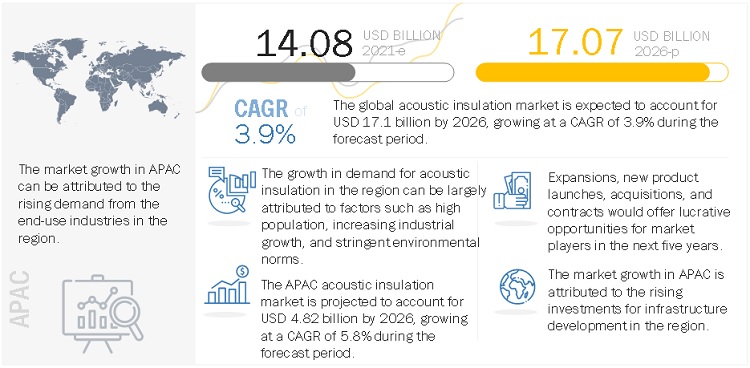
It turns out that the global acoustic insulation market is projected to grow from $14 billion today to more than $17 billion by 2026, according to Markets and Markets.
As Lios states in their pitch deck, “acoustic materials are all around us:”
As was the case with so many pitches, presentations and ideas buzzing around Ocean Exchange, what’s good for our oceans and environment can be great for other sectors and applications as well. I applaud all the innovators working to protect the 71% of our planet covered by oceans and thank them with a humble request that adjacent sectors borrow from such innovations and apply their technologies to the other 29% of the planet.