


How Martec Helped Valtech Decode the Software-Defined Future of Mobility
In automotive today, the conversation has shifted. It’s no longer just about engines, electrification, or even autonomy. Increasingly, competitive advantage is defined by something less visible, but far more transformative: software.
Vehicles are becoming platforms. Experiences are becoming products. And value is being created long after the moment of sale.
That shift is exactly what prompted Valtech—an experience innovation consultancy working closely with global automotive brands—to ask a critical question:
What’s really happening inside the industry as it transitions to a software-defined future?
To answer it, they turned to Martec (for the second year in a row).
The Challenge: Understanding a Market in Motion
Valtech operates at the intersection of customer experience, digital innovation, and emerging technology. Their role is to help automotive OEMs and suppliers rethink how they engage customers across the entire ownership journey.
But to do that credibly, they needed more than assumptions or surface-level trend analysis. They needed direct insight from the people shaping those decisions. Not just anyone in the organization, but senior decision-makers: executives, VPs, and directors responsible for innovation strategy, digital transformation, and customer experience.
And they needed those insights at a global scale.
As outlined in their recently released Voice of Experience Innovators: Mobility 2026 report, the industry is undergoing a fundamental shift, where “software now defines competitive advantage” and brands that align data, architecture, and experience will control long-term value. Understanding how leaders are responding to that shift—across regions, business models, and organizational roles—was the core objective.
The Approach: Reaching the Right Voices
This is where Martec’s role became essential. The research design combined both qualitative and quantitative methods:
- 100 global survey responses
- 22 in-depth executive interviews
- Representation across North America, Europe, China, Japan, and South Korea
- A mix of OEMs and suppliers, as well as premium and mass-market brands
But the methodology alone wasn’t what made the difference. The real challenge (and value) was in accessing the right people. Senior automotive leaders are among the most difficult audiences to reach. Their time is limited, their perspectives are guarded, and their participation requires both credibility and trust.
Martec’s ability to engage this audience consistently, and at scale, is what made the study possible. And just as importantly, the team remained flexible throughout the process. As Valtech refined its priorities, Martec adapted, adjusting interview scope, optimizing the balance between qualitative and quantitative inputs, and ensuring the final dataset aligned with both strategic goals and budget realities.
What Emerged: Clarity in a Complex Landscape
The findings themselves weren’t necessarily shocking. In many cases, they confirmed what many industry leaders and Valtech itself already suspected. But confirmation, when it comes from a rigorously structured, globally representative dataset, is powerful.
It transforms intuition into evidence.
One of the clearest examples was the rise of software-defined vehicles (SDVs). While the concept had been circulating for years, Martec’s prior research helped elevate the terminology itself in broader recognition and usage. In this year’s study, SDVs emerged as one of the most frequently cited themes among executives…second only to AI.

That evolution, from concept to common language, illustrates how research can shape not just understanding, but the conversation itself. Beyond terminology, the research revealed something more nuanced…and more actionable: The industry is not moving in a single direction. It’s fragmenting.
Regional Differences That Matter
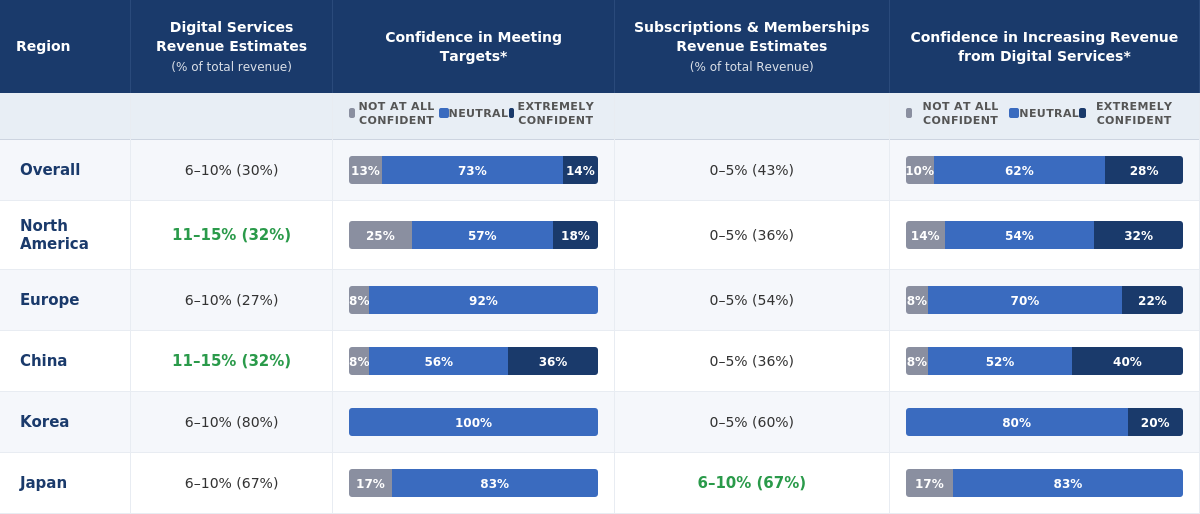
One of the most valuable outputs of the study was its ability to surface regional variation in how digital innovation is being approached. For example:
- Europe: Cost of investment emerged as the primary constraint.
- North America: Integration challenges dominated, reflecting the complexity of modernizing legacy systems.
- China: Manufacturers are further ahead in adopting and implementing digital innovation. Still, they are facing challenges that relate to data privacy, availability and compliance
- South Korea: OEMs are trying to keep up with technology evolving too fast
- Japan: Organizational structure appeared to be the main hurdle in manufacturers’ journey towards digital innovation
These differences matter. Because in a software-defined world, features can be updated, customized, and deployed differently by region, often without changing the physical vehicle itself. That creates both opportunity and complexity for OEMs trying to scale globally while remaining locally relevant.
Here is what the data revealed about regionality, which was crucial to understanding where innovation was coming from and having the most impact:
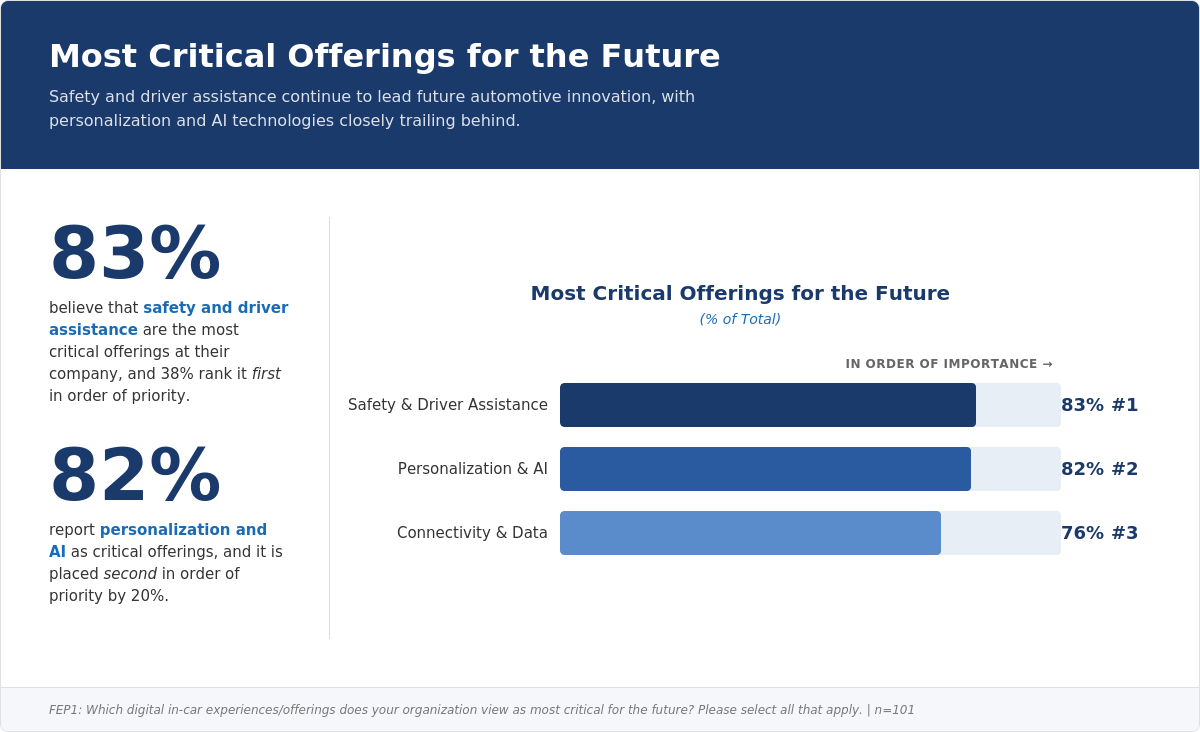
One of the key insights revealed during the research was what participants indicated to be the likely near-term future for this industry, a data point that Valtech’s audience would find particularly useful:
Organizational Tension Beneath the Surface
The research also surfaced internal dynamics that are shaping the pace of transformation. Across organizations, there is a growing disconnect between ambition and readiness. Valtech’s report notes that executive confidence in digital capabilities is actually declining, even as investment increases.
That paradox shows up in several ways:
- Customer experience is widely recognized as a top priority.
- But technical and organizational barriers persist.
- And different functions within the same company often view innovation through entirely different lenses.
Engineering leaders, for example, may prioritize system performance and integration. Marketing and CX leaders are focused on customer interaction and brand experience. Both perspectives are valid, but without alignment, progress slows.
The Value of Depth Over Headlines
Importantly, the most valuable insights weren’t necessarily the headline trends. They were the connections between variables.
Understanding that integration is a challenge is useful. Understanding that it is primarily a North American challenge, driven by specific organizational and technical factors, is actionable. That level of granularity is what transforms research into strategy. It allows clients like Valtech to move beyond general observations and toward targeted recommendations—tailored by region, company type, and organizational structure.
The Output: From Data to Industry Dialogue
While Martec delivered a comprehensive research report to Valtech, the final output took on a broader life. Valtech incorporated the findings into its publicly released Mobility 2026 report—designed to spark conversation across the industry.
The report explores:
- How customer expectations are evolving
- Why digital confidence is declining
- Where AI and SDVs are creating real value
- And what leading brands are doing differently
It positions the shift not as a future possibility, but as a present reality.
As the report states, “vehicles are becoming platforms,” and value is increasingly created through ongoing digital interactions . In that sense, the research didn’t just answer questions. It helped shape the narrative.
What This Project Demonstrates
For Martec, this engagement reinforces a broader point: In fast-moving markets, the challenge isn’t a lack of information; it’s a lack of reliable, decision-grade insight. In the modern world, information is plentiful, but insights and intelligence remain scarce. To extract them requires:
- access to the right audiences
- a methodology that balances breadth and depth
- and the ability to interpret not just what’s happening, but why
It also requires a willingness to go beyond the brief. Whether that meant refining the research design, re-engaging participants, or supporting downstream initiatives like webinars and thought leadership, the Martec team operated as a true partner, not just a vendor.
“Finding research partners who can actually tap into senior levels at automotive OEMs globally is a challenge…doing it at scale is even harder,” said Denny Pezic, Global Vertical Lead, Automotive & Mobility at Valtech. “Martec stood out immediately with their ability to navigate those complex HQ relationships efficiently. Their ability to reach senior automotive leaders globally at scale is impressive, but it’s their hands-on approach and reliability that make them a standout partner.”
A Model for Future Engagements
As industries continue to evolve—especially those being reshaped by software, data, and AI—the need for this kind of research will only grow.
Organizations don’t just need answers. They need clarity. Clarity about where the market is going. Clarity about how their peers are responding. And clarity about what actions to take next.
This project with Valtech is a clear example of how that clarity is built. Not from assumptions, but from the voices of the people closest to the decisions that matter most.