

Why the goal of pricing research is not to find a single “right number,” but to understand the market well enough to make better decisions.
Ask a customer what they would pay for your product and they will almost certainly give you an answer. They will often do so confidently. In fact, many will provide a level of precision that suggests they have carefully thought through the issue before. But there is a fundamental challenge with taking that answer at face value: purchasing decisions rarely occur in the clean, controlled environment in which pricing questions are asked.
Real-world buying decisions are shaped by budgets, alternatives, internal approvals, competitive offers, timing, risk, and countless other factors that may not be fully considered when someone is asked a direct willingness-to-pay question. As a result, the answer a customer provides may be entirely honest, thoughtfully considered, and directionally useful, while still differing from what they ultimately do when faced with an actual purchasing decision.
Some interpret this as evidence that direct pricing questions should not be asked. We would argue the opposite.
The issue is not that customers struggle to perfectly predict their future behavior. The issue is that many organizations expect a single pricing methodology to answer every pricing question they face. In reality, different pricing methodologies are designed to answer different questions, and understanding those differences is often what separates an effective pricing strategy from an expensive mistake.
Understanding What Direct Pricing Questions Actually Measure
One of the most common criticisms of direct willingness-to-pay questions is that they do not always predict actual purchase behavior. That criticism is largely fair. A respondent answering a survey or participating in an interview is operating in a hypothetical environment. No money is being exchanged. No competitive quote is sitting on their desk. No procurement manager is challenging the purchase. No budget constraints have suddenly emerged.
However, concluding that the information lacks value would be a mistake.
Direct pricing questions often reveal something incredibly important: how customers think about value. They help organizations understand pricing expectations, identify psychological thresholds, uncover perceptions of fairness, and provide insight into how a market frames purchasing decisions. While they may not provide a precise forecast of future behavior, they can offer valuable context that would be difficult to uncover through other means.
In other words, direct pricing questions may not always tell you exactly what customers will do, but they can provide important clues about why they do it.
Stated Preference and Revealed Preference Are Not Competitors
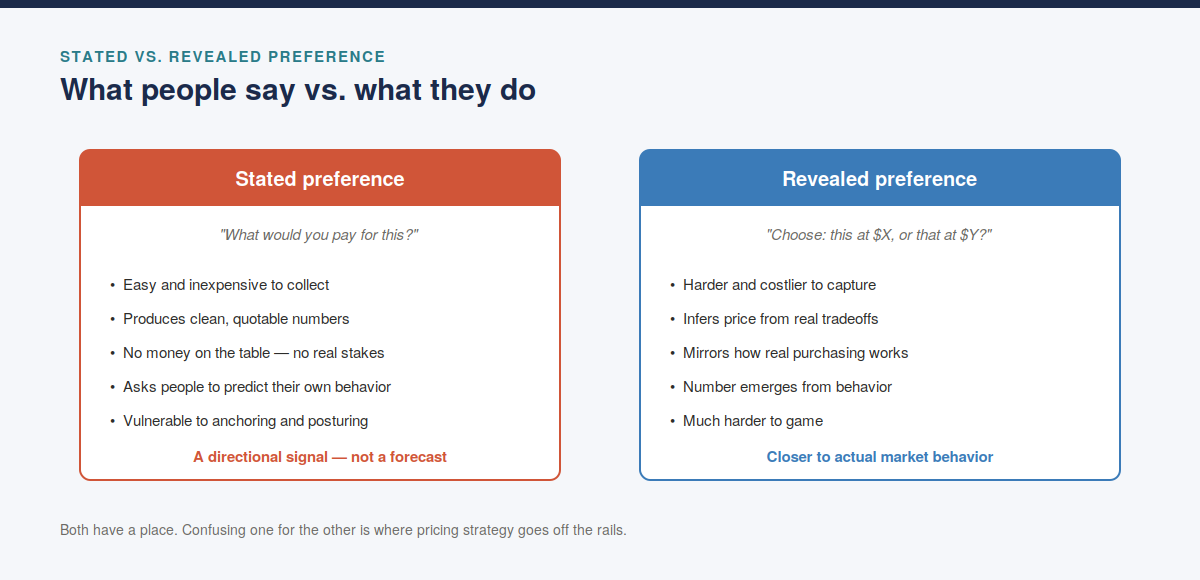
Many pricing discussions eventually arrive at the distinction between stated preference and revealed preference. Stated preference captures what customers say. Revealed preference attempts to capture what customers do when confronted with realistic tradeoffs. Too often, these approaches are presented as competing methodologies, when, in reality, they are often complementary sources of insight.
Stated-preference approaches can help companies understand customer perceptions, evaluate reactions to pricing concepts, and identify acceptable pricing boundaries. Revealed-preference approaches, such as conjoint analysis and discrete choice modeling, help organizations estimate how customers may behave when choosing between alternatives with different combinations of features, benefits, and price points.
Neither approach is universally superior. Each provides a different lens through which to view a market. The most effective pricing strategies often emerge when organizations understand the strengths and limitations of both perspectives rather than treating one as inherently better than the other.
The Real Question Is Not “Which Methodology Is Best?”
After working on pricing engagements across a variety of industries, we have found that organizations often ask the wrong question when evaluating research approaches. The debate is frequently framed as whether conjoint is better than Van Westendorp, whether qualitative pricing research is more useful than survey-based approaches, or whether stated-preference methods should be replaced by behavioral modeling.
In most cases, that debate misses the point. A better question is whether the methodology aligns with the decision that needs to be made.
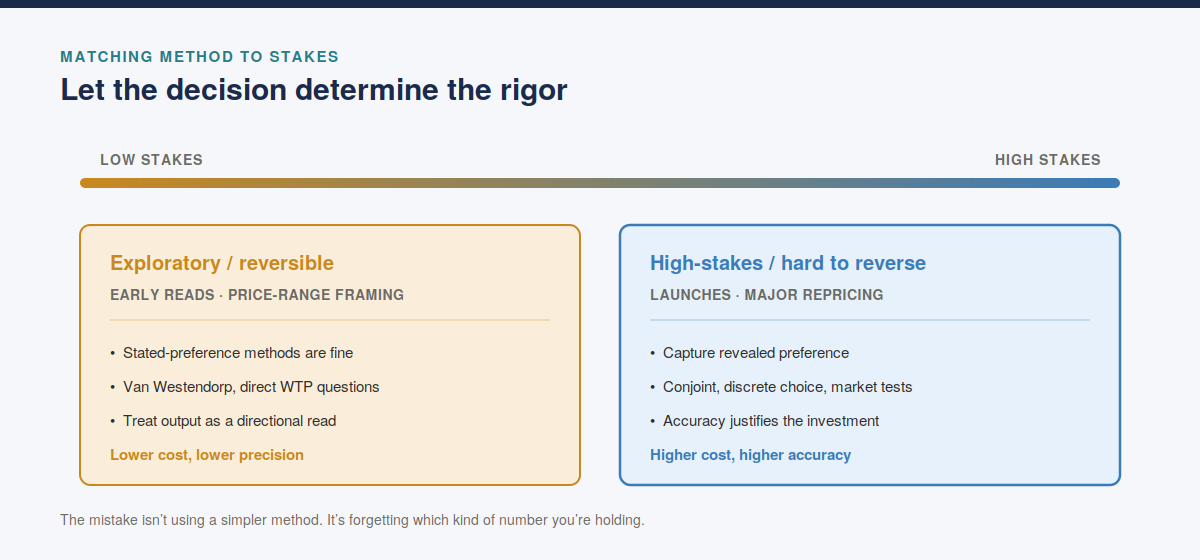
An organization attempting to establish directional pricing guidance for a new concept faces a very different challenge than a company preparing to launch a multimillion-dollar product platform. Likewise, a business seeking to understand customer perceptions of value may require a different approach than one attempting to quantify the likely impact of a broad-based price increase.
The methodology should follow the business decision. Not the other way around.
Where Pricing Research Goes Wrong
When pricing research disappoints, the root cause is rarely the methodology itself. More often, the problem is that organizations ask a methodology to answer questions it was never designed to address.
A direct willingness-to-pay exercise may be used as if it were a precise forecast of market behavior. A conjoint model may be interpreted as an exact prediction of future sales performance. A qualitative interview program may be treated as though it provides statistically projectable findings.
None of those outcomes represent a failure of the methodology. They represent a mismatch between expectations and purpose.
Every pricing methodology provides insight into customer decision-making. The key is understanding which part of the decision-making process is being illuminated and where additional information may be required.
The Bottom Line for Pricing Leaders
Pricing decisions are often among the most consequential decisions an organization can make. A price that is too high can limit adoption and market penetration. A price that is too low can leave substantial margin unrealized for years. A poorly executed price increase can create unnecessary customer disruption, while an overly cautious approach can result in avoidable profit erosion.
Given those stakes, the objective should not be to identify a single “best” pricing methodology. The objective should be to understand which methodology—or combination of methodologies—provides the level of insight required to make the decision with confidence.
The organizations that consistently make strong pricing decisions are not necessarily those with the most sophisticated models or the largest datasets. They are the ones that understand what their information can and cannot tell them. They recognize that pricing research is ultimately a decision-support tool, not a crystal ball, and they match the rigor of the methodology to the importance of the decision.
Customers may not always know exactly what they would pay. But that does not make their perspective any less valuable. The real challenge is understanding what their answers mean, where they provide insight, and how they should be combined with other evidence to build a pricing strategy grounded in reality rather than assumptions.