

Weighing the Consequences of Being Wrong Against the Rewards of Being Right
Imagine you’re leading a manufacturing company that has just absorbed a series of cost increases. Some are tied to raw materials. Others stem from labor, freight, or supplier adjustments. Regardless of the source, the impact is significant enough that leadership agrees some level of pricing action is necessary.
That is usually where the real debate begins.
One group advocates for a modest increase. Their concern is understandable: customer relationships took years to build, and pushing too aggressively could introduce unnecessary risk. Another group supports a more substantial increase, arguing that margin pressure has become too significant to ignore. A third group lands somewhere between those positions, proposing a balanced approach that attempts to recover costs while minimizing customer disruption.
The challenge is that each perspective may be perfectly reasonable. Each is built on assumptions that appear logical based on the information available today. And each has the potential to be either right or wrong once the market ultimately responds.
This is what makes pricing decisions so difficult. The need for action is often clear. The customer response is not.
Three Reasonable Paths Forward
Organizations can gather customer feedback, assess competitive alternatives, and invest in pricing research to better understand market dynamics. All of those efforts help reduce uncertainty, but they rarely eliminate it.
Customers do not always behave the way they say they will. Competitors do not always respond the way we expect. Market conditions can shift unexpectedly. Even the most thoughtful analysis cannot fully predict how buyers, distributors, procurement teams, and competitors will react once new prices are announced.
Faced with this reality, most leadership teams naturally turn to forecasting. They examine historical behavior, estimate elasticity, model demand, and attempt to identify the outcome that appears most likely.
There is nothing wrong with that approach. Forecasting is an essential component of sound pricing strategy. The challenge is that pricing decisions are ultimately judged by what actually happens in the marketplace, not by what the forecast predicted.
Evaluate the Downside of Each Path
This is where the minimax mindset discussed in the previous article becomes useful. Rather than focusing exclusively on the most likely outcome, minimax-inspired thinking encourages leaders to consider what happens if their assumptions prove incorrect. In other words, instead of concentrating solely on expected returns, organizations also examine the downside associated with each available path.
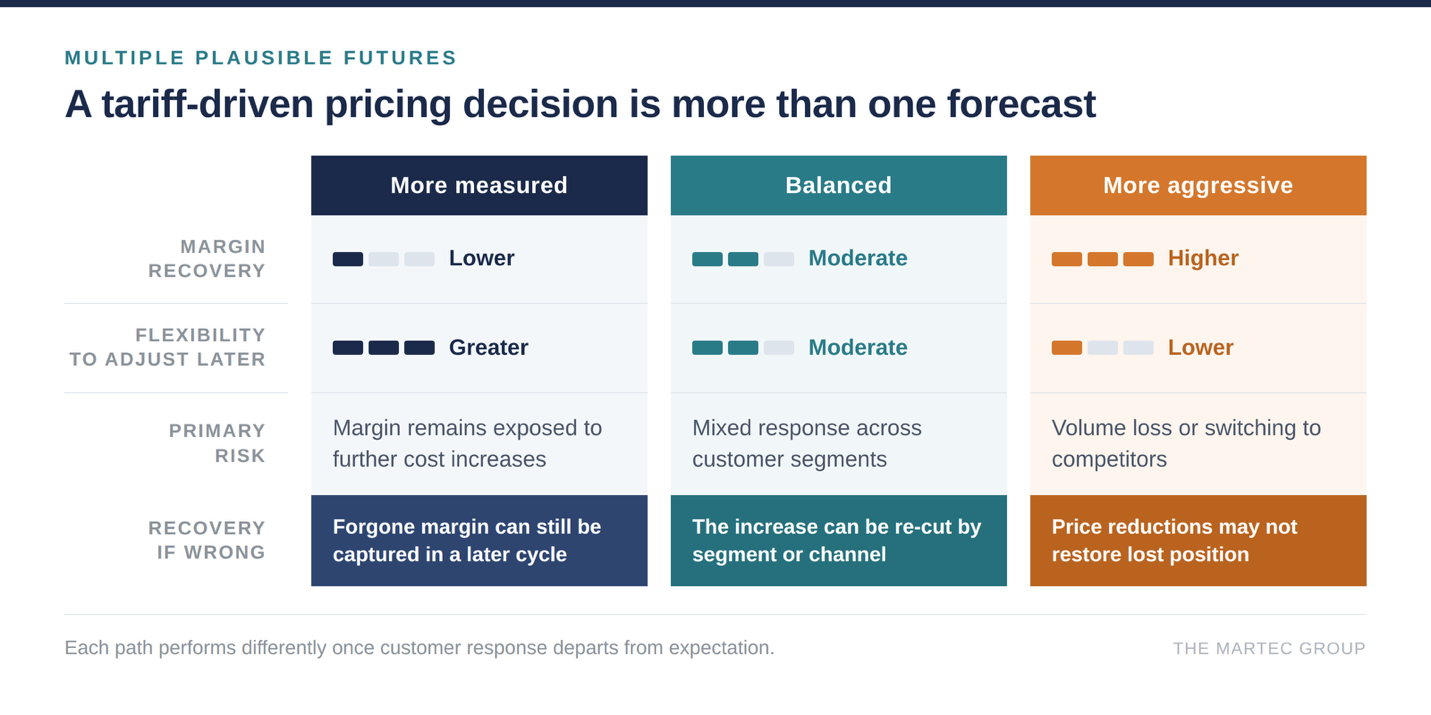
Consider an aggressive price increase. If customers largely accept it, the outcome can be highly attractive. Margins improve, profitability is protected, and the business successfully offsets rising costs. Viewed through a traditional lens, the decision may appear to be the obvious choice.
But what happens if the underlying assumptions are wrong? What if customers begin actively evaluating alternative suppliers? What if distributors push back more aggressively than expected? What if procurement teams launch sourcing exercises that previously were not being considered? In some situations, the consequences may extend well beyond the immediate impact of the price increase itself.
The same logic applies in the opposite direction. A modest increase may fail to recover enough of the company’s rising costs, particularly if customers would have accepted a larger adjustment with little resistance. Leadership may later conclude that it underestimated pricing power and sacrificed profitability unnecessarily.
That outcome is certainly undesirable, but it raises an important question: how recoverable is the mistake?
Why Recoverability Changes the Conversation
When pricing teams evaluate risk, they often focus on the magnitude of potential gains and losses. Minimax-inspired thinking introduces another important dimension by considering how easily those outcomes can be corrected if reality unfolds differently than expected.
If a company increases prices conservatively and discovers the market would have tolerated more, can it implement a follow-on increase? Can it adjust discount structures? Can it take a more targeted pricing action in specific customer segments?
The answers will vary by industry and situation, but the broader principle remains the same. The risk associated with a pricing decision is not determined solely by its financial impact. It is also influenced by how much flexibility the organization retains if market conditions evolve differently than anticipated.
Thinking this way often changes the discussion in meaningful ways. Instead of asking only which option produces the highest expected return, leadership teams begin evaluating the consequences associated with alternative futures. Which outcome would create the greatest disruption? Which assumptions carry the most uncertainty? Which mistakes would be easiest to correct?
Those questions frequently reveal risks and opportunities that traditional forecasts alone may overlook.
Not All Customers Create the Same Risk
One of the limitations of many pricing discussions is the implicit assumption that all customers will respond in roughly the same way. In practice, that is rarely the case.
Customer reactions often vary based on switching costs, the availability of competitive alternatives, technical requirements, contractual obligations, and the customer’s ability to pass costs through. A buyer with several qualified supplier options may respond very differently than a customer operating within a highly specialized application where alternatives are limited.
Recognizing those differences allows organizations to evaluate risk at a segment level rather than treating the market as a single, uniform entity. In many situations, the strongest pricing strategy is not a single answer applied broadly across the customer base. Instead, it is a differentiated approach that reflects varying levels of opportunity, exposure, and risk across customers, applications, channels, or end markets.
Segmentation will not eliminate uncertainty, but it can help focus attention on the areas where downside exposure is greatest and where thoughtful pricing decisions matter most.
Research Improves the Forecast.
Minimax Improves the Decision.
This is one reason pricing research and minimax-inspired thinking work so well together. Pricing research helps organizations understand the path that is most likely to occur. It provides insight into customer value, willingness to pay, competitive positioning, and pricing power. Those insights improve leadership’s ability to forecast market reactions and make informed decisions.
Minimax-inspired thinking complements that process by forcing leaders to consider what happens if some of those conclusions prove incomplete, inaccurate, or only partially correct. Research helps identify the most probable future. Minimax helps evaluate whether a pricing strategy remains resilient across a wider range of plausible futures.
Together, they create a more balanced framework for decision-making.
Making Decisions That Hold Up Across Plausible Futures
Ultimately, uncertainty is not something pricing leaders can eliminate. It is something they must manage.
The organizations that navigate uncertainty most successfully are rarely those that predict every market reaction perfectly. More often, they are the organizations that understand the limits of forecasting, recognize the risks embedded within their assumptions, and build flexibility into their pricing decisions. That may be the most practical lesson minimax offers pricing professionals.
It is not a formula for determining the perfect price. It is a framework for thinking more clearly when certainty is impossible, assumptions matter, and the consequences of being wrong can be just as important as the rewards of being right.