
Applying “Minimax” to Thoughtfully Consider Worst-Case Scenarios
Most pricing discussions begin with confidence and end with uncertainty. A leadership team gathers around a conference room table to evaluate a potential pricing action. Research has been completed. Competitive intelligence has been collected. Finance has modeled the impact of several scenarios. The sales team has weighed in on likely customer reactions. By all appearances, the organization has done everything right.
Yet as the discussion unfolds, a familiar realization emerges. Nobody actually knows what will happen:
Will customers push back more aggressively than expected?
Will competitors follow with similar increases or attempt to gain share by holding prices steady?
Will distributors absorb the change, resist it, or look for concessions elsewhere?
Every stakeholder has a perspective, but no one has certainty.
Despite that reality, most pricing decisions are still evaluated through a relatively narrow lens. Organizations focus on identifying the option that appears most likely to produce the best outcome. They forecast volume, estimate margins, project customer retention, and attempt to determine the path that maximizes financial performance.
There is nothing inherently wrong with this approach. In fact, it is essential. Pricing decisions should be informed by the best available information. The challenge is that markets do not always behave the way forecasts predict.
The issue is not that organizations lack data. The issue is that uncertainty remains even after the data has been collected.
Forecasts Are Necessary. Certainty Is Not.
This raises an important question. If pricing decisions are inherently uncertain, should they be evaluated solely based on what we expect to happen? Or should they also be evaluated based on what happens if our assumptions prove wrong?
That question led me to revisit a concept from decision theory known as minimax.
The theory itself is not particularly important for pricing professionals. Most organizations are not going to build formal minimax models when making commercial decisions—nor should they. What is interesting, however, is the mindset behind the framework.
In its simplest form, minimax encourages decision-makers to consider the worst plausible outcome associated with each available option. Rather than focusing exclusively on the most likely result, it asks leaders to understand the downside attached to being wrong. For pricing teams, that perspective can be surprisingly valuable.
Expected Outcomes Are Only Part of the Story
Much of traditional pricing analysis focuses on expected outcomes. Organizations debate how much volume may decline, how much margin may improve, whether competitors are likely to follow, and how customers are expected to react. These conversations are critical because they help quantify potential rewards.
What they often fail to do is fully quantify downside exposure.
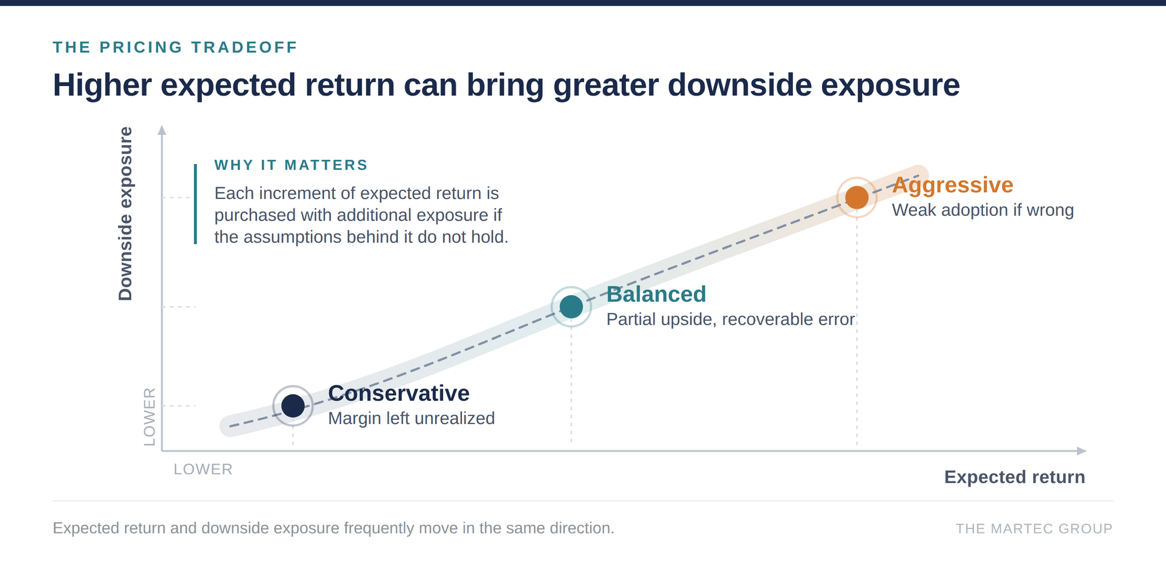
Organizations naturally pursue opportunities that appear to offer greater upside. Yet the potential rewards associated with a decision are often accompanied by greater exposure if the underlying assumptions do not hold. In pricing, the most attractive forecast on paper is not always the most resilient decision in practice.
Not All Risks Are Created Equal
Consider two pricing decisions that ultimately miss the mark.
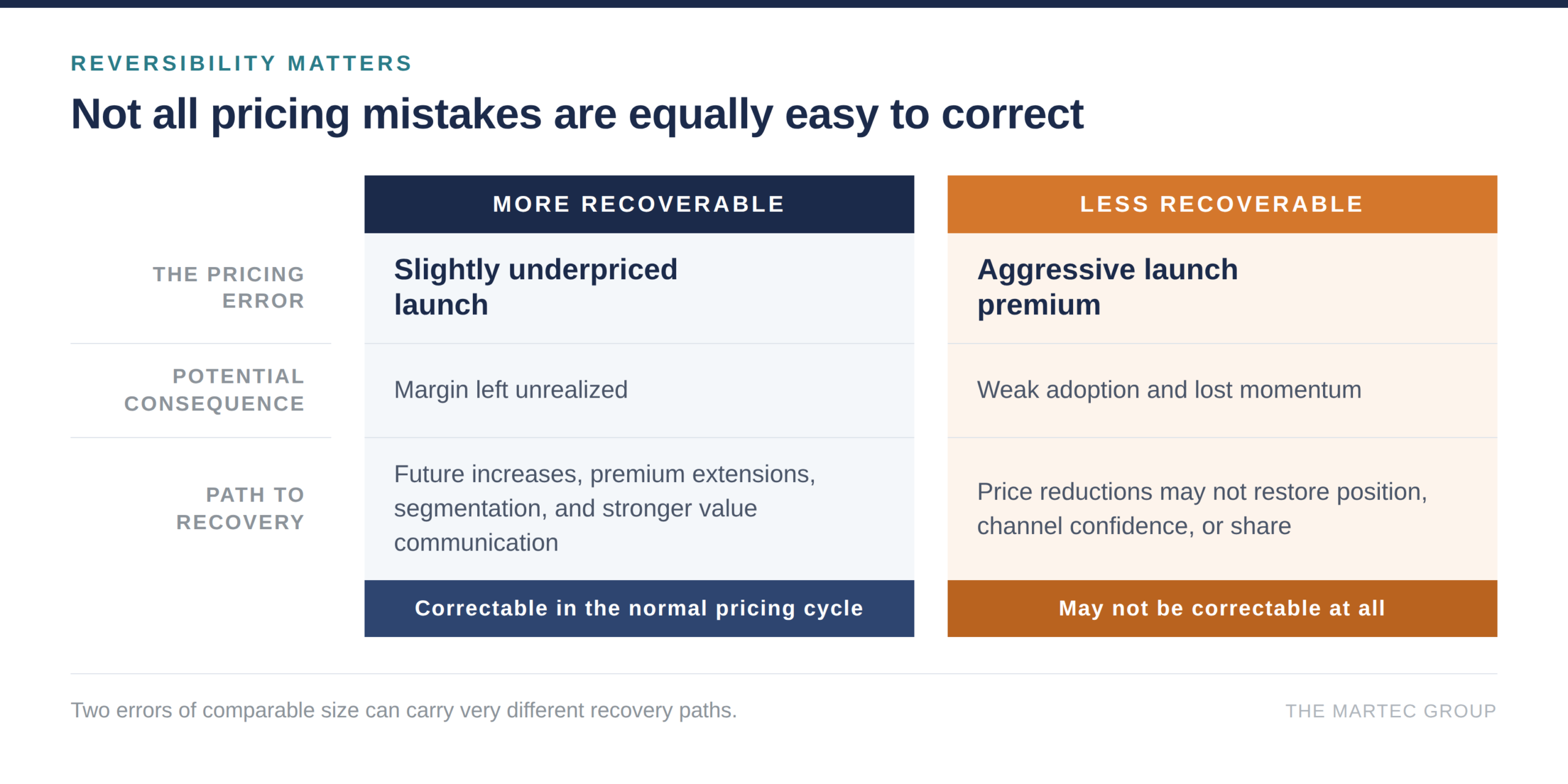
In one scenario, a company increases prices less than customers would have tolerated. Margins suffer, profitability falls short of expectations, and leadership concludes that the organization left money on the table.
In another scenario, a company pushes prices significantly beyond what customers perceive as reasonable. Customers begin evaluating alternatives, giving competitors a closer look, or reassessing long-standing supplier relationships.
Both outcomes represent forecasting errors. However, they do not create the same consequences. The first may be frustrating. The second may fundamentally alter customer behavior. That nuance matters because not all pricing mistakes are equally difficult to recover from.
The Difference Between Being Wrong and Being Wrong Forever
One of the most practical insights minimax-inspired thinking provides is the recognition that downside risk is not simply about probability. It is also about severity and recoverability. A relatively unlikely event may deserve greater attention if its consequences are significant and difficult to reverse. Conversely, a more probable outcome may require less concern if the organization can quickly adapt.
This shifts the discussion from What outcome is most likely? to What happens if we are wrong? While those questions may sound similar, they often lead to very different conversations.
When applying minimax thinking to their pricing strategy conversations, organizations begin evaluating not only the attractiveness of an opportunity, but their ability to navigate alternative futures as well. They become more deliberate about identifying assumptions, stress-testing strategies, and understanding which risks have the potential to create lasting consequences.
Research Can Reduce Uncertainty, But Not Eliminate It
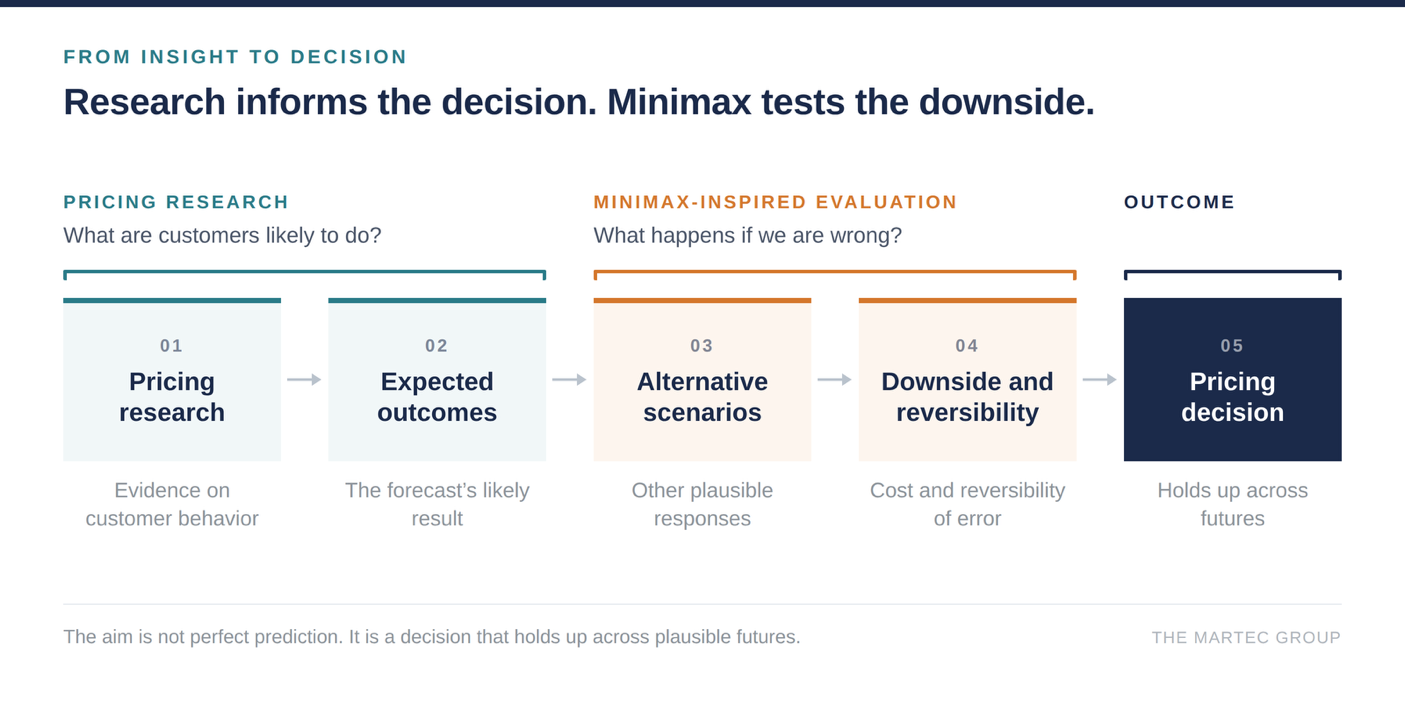
Importantly, this does not diminish the role of pricing research. If anything, it reinforces its value. Research remains one of the most effective ways to reduce uncertainty and improve decision quality. Customer interviews, willingness-to-pay studies, market testing, and competitive analysis all provide critical insight into likely market behavior.
However, even the best research cannot eliminate uncertainty entirely. Research improves our understanding of likely customer behavior; it does not provide a guarantee that customers will behave exactly as expected. This is where minimax-inspired thinking becomes valuable. Rather than replacing research, it serves as a complementary framework for evaluating decisions in light of the uncertainty that inevitably remains.
Making Better Decisions Under Uncertainty
Ultimately, the most important lesson may be that pricing decisions should not be judged exclusively by their expected outcomes. They should also be evaluated by their exposure to downside risk, their resilience under alternative scenarios, and the organization’s ability to adapt if market reactions diverge from expectations.
The strongest pricing organizations understand that no amount of analysis will eliminate uncertainty entirely. Instead, they focus on making decisions that are informed, resilient, and adaptable.
Perhaps that is the real lesson behind minimax.
The goal is not to identify the perfect pricing decision. The goal is to make the best decision possible while recognizing that the future rarely behaves exactly as planned.
Sometimes that means focusing not only on the upside of being right, but also on the consequences of being wrong.