

How manufacturers can use value intelligence to navigate input cost volatility without leaving margin on the table.
Ongoing tariff actions have forced manufacturers to confront a challenge many have not faced in years. What happens when the cost of goods sold jumps 15%, 20%, or more over a relatively short period of time? For many organizations, the initial response is understandable: update the cost models, recalculate margins, determine how much of the increase can be passed through to customers, and implement the necessary changes.
Some companies have moved aggressively, assuming the market would absorb higher prices. Others have hesitated, concerned about triggering volume loss or damaging customer relationships. Most have landed somewhere in the middle, implementing partial increases without a clear understanding of what customers value, how price-sensitive they are, or how they are likely to respond. That uncertainty creates risk, particularly when margins are already under pressure and decisions need to be made quickly.
This is precisely the point at which market intelligence becomes most valuable. Unfortunately, it is also when many organizations are least likely to invest in gathering it. The pressure to act can lead companies to rely on assumptions, historical precedent, or internal opinions rather than evidence from the market itself. In a stable environment, that may lead to missed opportunities. In a volatile environment, it can lead to expensive mistakes.
The Fallacy That Costs Translate Directly to Price Increases
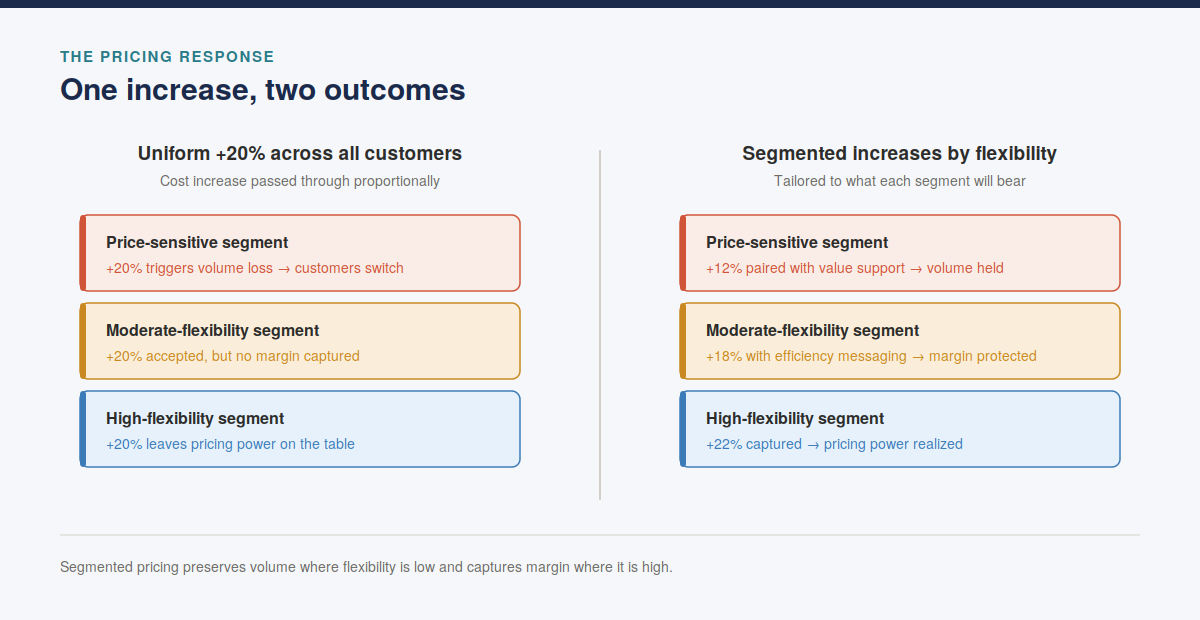
At first glance, pricing in a tariff environment appears straightforward. Input costs rise by 20%, prices rise by 20%, and margins are preserved. The logic is simple and often serves as the foundation for internal pricing discussions. The problem is that customers do not make purchasing decisions based on your cost structure. They make purchasing decisions based on the value they receive and the alternatives available to them.
That distinction becomes increasingly important during periods of cost volatility. Your costs may have increased, but your competitors’ costs may have increased as well. Your customers may also be dealing with higher input costs and margin pressures of their own. As a result, the key question is not whether a price increase can be justified internally. The more important question is how customers are likely to respond once the increase reaches the market.
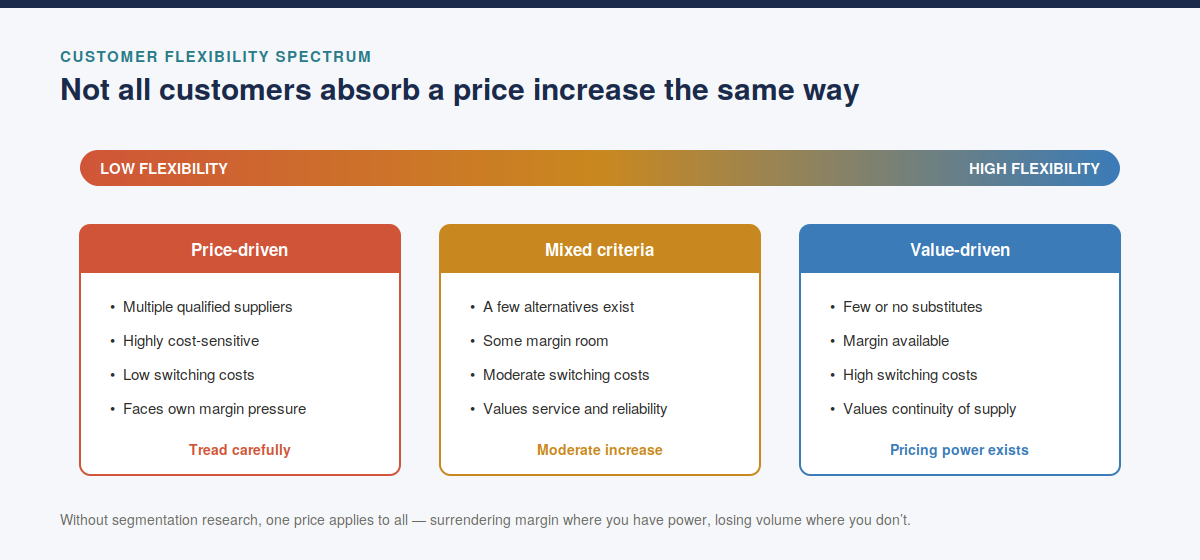
Some customers will absorb higher prices with minimal impact. Others may look for lower-cost alternatives, consolidate suppliers, redesign products, or delay purchases altogether. Those responses rarely occur uniformly across a customer base. Customers differ by industry, application, competitive environment, switching costs, qualification requirements, and their own financial pressures. Treating all of them the same may simplify decision making internally, but it often obscures where pricing power actually exists.
Where Companies Get This Wrong
One of the most common mistakes manufacturers make during periods of tariff-related pressure is assuming that a uniform cost increase should produce a uniform pricing response. While tariffs may affect a supplier’s cost structure relatively consistently, customer willingness to pay rarely behaves that way. The customer facing multiple qualified suppliers and significant margin pressure is likely to react very differently than the customer whose operation depends on a difficult-to-replace product or supplier relationship.
Another common mistake is confusing cost justification with value justification. A company may be entirely justified in raising prices because its costs have increased. That does not automatically mean customers will view the increase favorably. Customers evaluate pricing decisions in the context of the value they receive. Organizations that successfully navigate tariff-related increases are often the ones that clearly communicate both the source of the cost pressure and the factors that continue to differentiate their offering in the market. They help customers understand not only why prices are changing, but why the value proposition remains compelling.
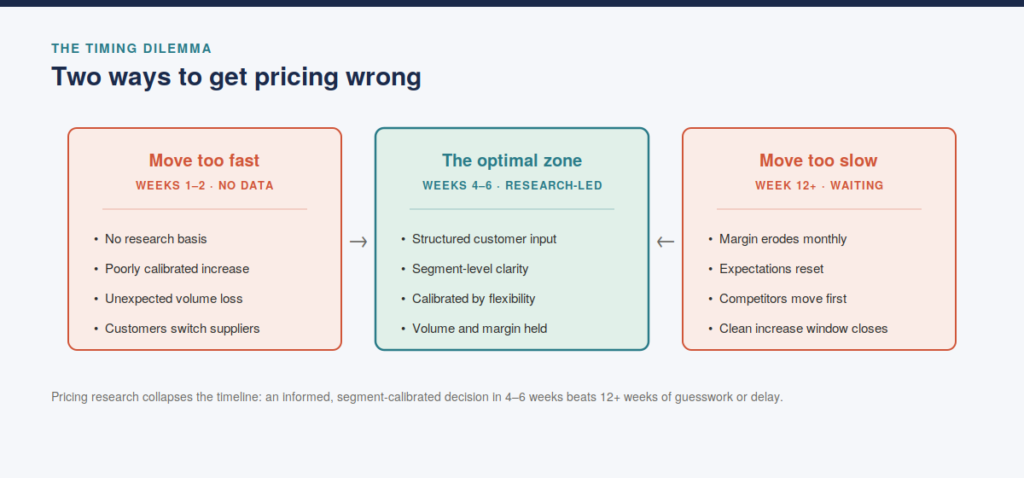
A third mistake is simply waiting too long. Faced with uncertainty, many organizations hope conditions will stabilize before acting. Meanwhile, margins continue to erode, competitors begin establishing new pricing norms, and customer expectations start to reset. By the time a company is prepared to move, the market may have already adapted, making implementation more difficult than it would have been earlier.
How Value Perception Changes the Equation
Periods of cost volatility force organizations to think differently about pricing. In stable markets, pricing initiatives are often focused on optimization and incremental margin improvement. When tariffs or other disruptions occur, the conversation shifts toward understanding how much pricing flexibility actually exists and where the business is most vulnerable.
Consider a customer currently paying $100 for a product that now needs to be priced at $120. The challenge is not simply whether the customer can afford the additional $20. The more important question is whether the customer’s perception of value supports the increase. If the offering is viewed largely as a commodity, the reaction may be very different than if the customer values reliability, technical support, innovation, customization, product performance, or continuity of supply.
The companies that navigate these situations most effectively typically understand these dynamics before implementing major pricing changes. They know which segments are highly price-sensitive, which customers perceive meaningful differentiation, and where genuine pricing power exists. As a result, they can make strategic decisions rather than applying a single solution across very different customer groups.
What Better Decision-Making Looks Like
The challenge facing manufacturers in a tariff environment is not determining whether prices should increase. In many situations, cost pressures make some level of increase unavoidable. The more difficult question is where those increases can be implemented successfully, how customers are likely to respond, and which segments create the greatest risk to margins or volume. Those answers are rarely obvious from internal financial models alone.

Many leadership teams understand their costs in extraordinary detail but have far less visibility into how customers are likely to react once pricing changes reach the market. As a result, pricing discussions often become dominated by internal assumptions. Some believe customers have no choice but to accept the increase. Others assume any increase will trigger significant volume loss. Both positions may be directionally correct for certain customers and completely wrong for others.
This is where market intelligence becomes valuable. Whether through customer interviews, pricing research, market testing, or a combination of approaches, the objective is not to find a perfect answer. It is to reduce uncertainty and improve decision quality. Understanding which customers are likely to absorb an increase, which are highly price-sensitive, and which may alter their purchasing behavior allows organizations to make considerably more informed decisions than simply applying a broad pricing adjustment across the entire market.
In practice, companies often discover that pricing power is not distributed evenly across customers, products, or applications. Certain segments may be far less sensitive than originally assumed, creating opportunities to recover margin more aggressively. Others may require a more measured approach because competitive pressure, customer economics, or substitution risk creates greater vulnerability. Once those differences become visible, pricing decisions can be tailored to the realities of the market rather than the convenience of a one-size-fits-all strategy.
The Cost of Waiting
Every month a company delays a necessary price adjustment represents margin erosion that is often difficult—and sometimes impossible—to recover. Customers adapt to existing prices, competitors establish new market expectations, and internal financial pressures continue to build. While uncertainty may create a temptation to wait, inaction is often a decision in its own right…and not always a cost-free one.
At the same time, moving too aggressively without understanding the market carries its own set of risks. A poorly calibrated increase can trigger unexpected volume loss, accelerate supplier switching, or encourage customers to pursue redesign efforts that permanently reduce demand. The consequences may not appear immediately, but they can have a lasting impact on both revenue and market position.
The most effective organizations recognize that pricing decisions made during periods of disruption require balancing two competing risks. The first is the risk of acting too slowly and unnecessarily sacrificing margin. The second is the risk of acting too aggressively and damaging customer relationships or market share. The objective is not simply to move quickly or cautiously. It is to move with confidence because the decision is grounded in a clear understanding of how customers perceive value and how they are likely to respond.
The Real Risk Isn’t the Tariff
In volatile markets, pricing is ultimately a strategic decision, not a mathematical exercise. Cost increases may create the need for action, but they do not determine how the market will respond. Customers evaluate price changes through the lens of value, competitive alternatives, switching costs, and their own business realities. Understanding those factors is often the difference between preserving margins and damaging long-term growth.
The manufacturers that navigate periods of disruption most successfully are rarely those that react the fastest or implement the largest increases. More often, they are the organizations that understand their market well enough to know where pricing power exists, where flexibility is limited, and where different customer groups require different approaches. They recognize that pricing decisions are ultimately market decisions, and the strongest pricing strategies begin with understanding how the market is likely to behave.
That understanding does not come from a spreadsheet alone. It comes from the market.