

How the Construction Industry’s Labor Shortage Is Quietly Reshaping What Contractors Buy, What They Choose, and What Makes a Brand Worth Specifying
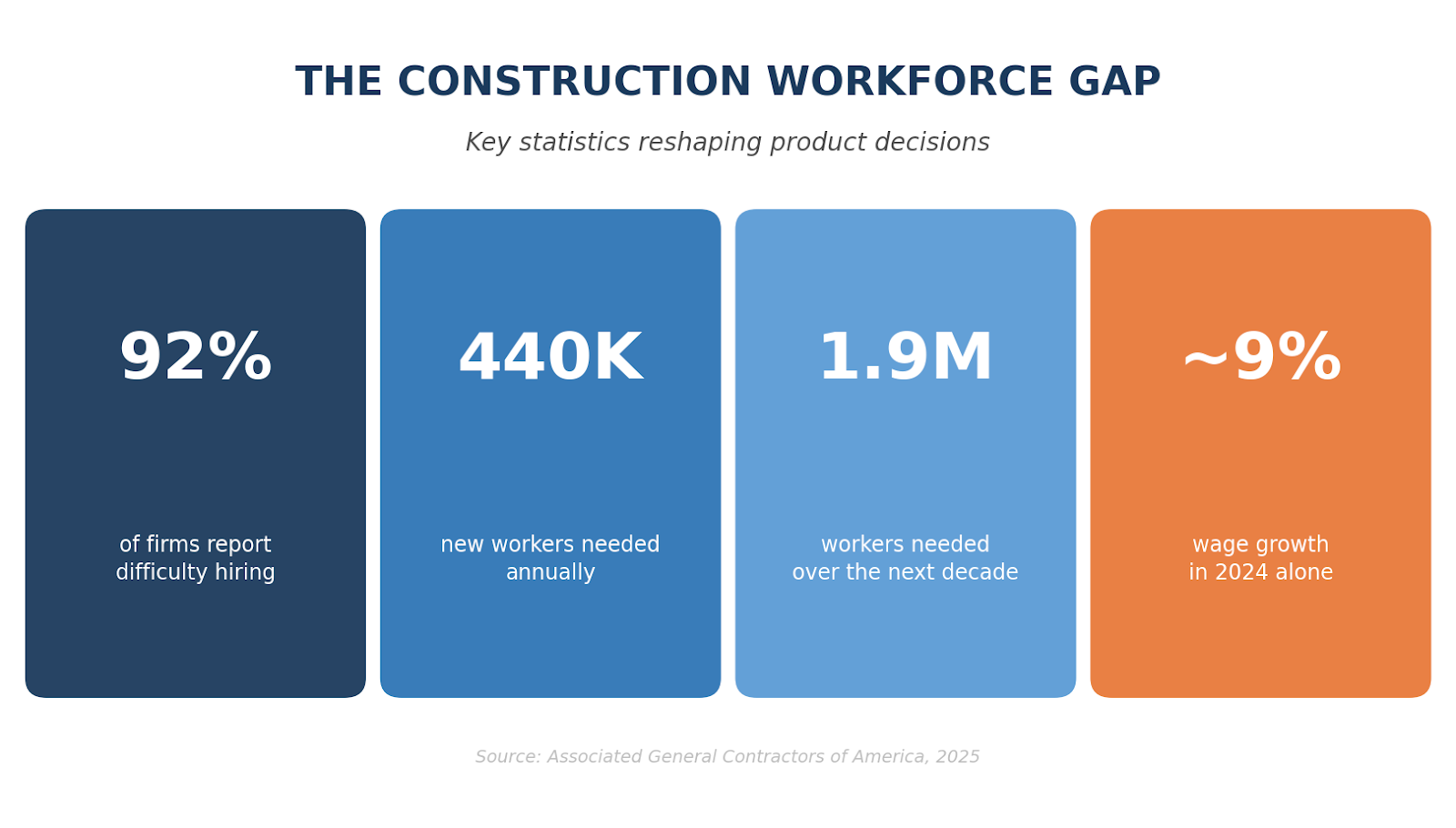
The construction industry is facing a workforce crisis that shows no signs of resolving quickly. According to the Associated General Contractors of America, 92% of construction firms reported difficulty filling open positions in 2025, and labor shortages have become the single leading cause of project delays industry-wide. The industry needs to attract roughly 440,000 new workers annually just to keep pace with demand. Over the next decade, that number balloons to 1.9 million.
Most of the conversation around this crisis centers on recruitment, training, immigration policy, and wages. Those are legitimate concerns. But there is a parallel story that is getting far less attention, and it matters enormously to the brands, manufacturers, and suppliers who sell into the construction market: the labor shortage is fundamentally changing how contractors, builders, and tradespeople make product decisions.
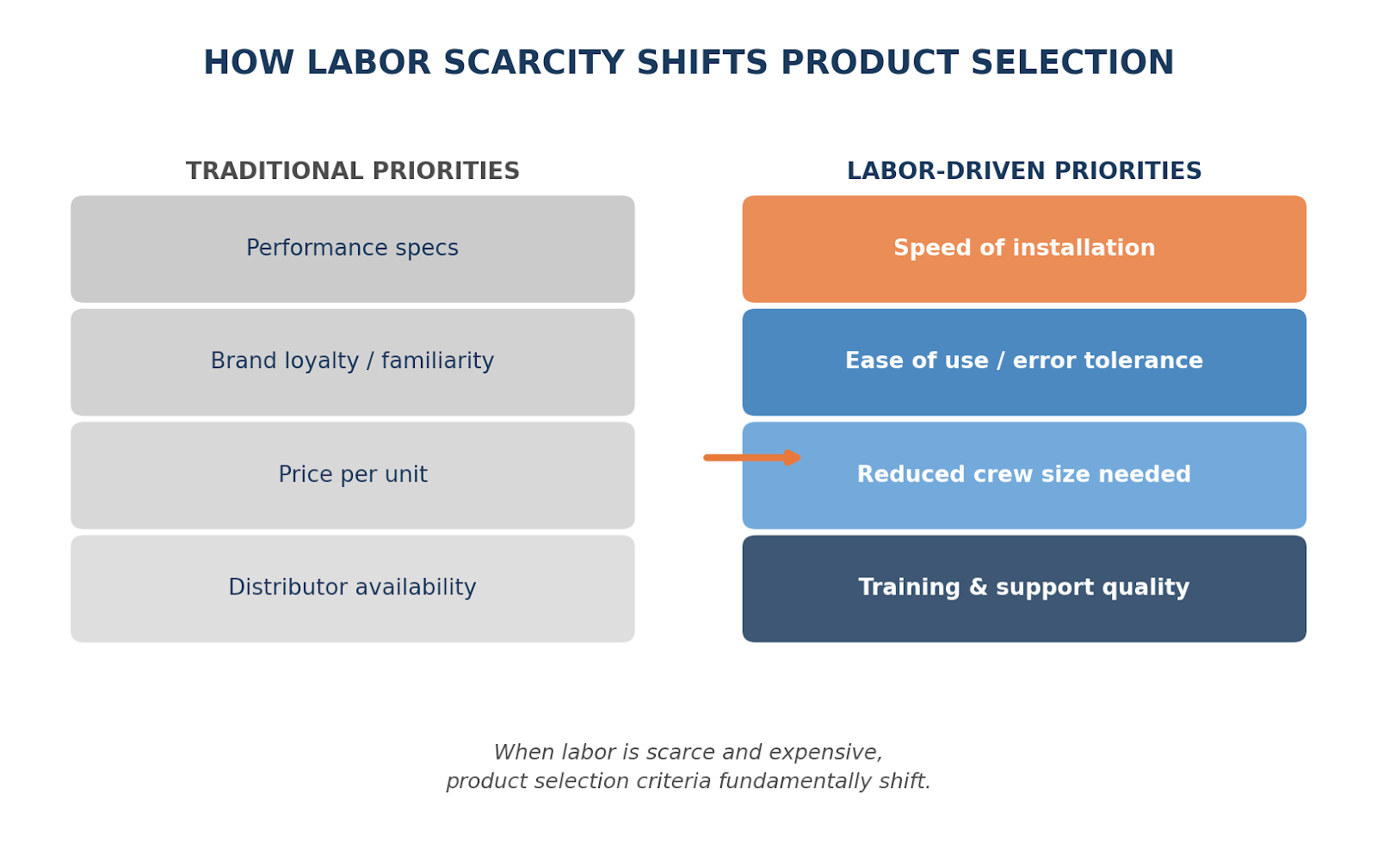
At The Martec Group, we have spent decades conducting qualitative and quantitative research with professionals across the construction ecosystem, from residential framers and commercial subcontractors to industrial maintenance crews and specialty trade contractors. What we are hearing from the field tells a clear and consistent story: when labor is scarce and expensive, product selection criteria shift. And most manufacturers have not caught up.
When Every Hour on the Job Costs More, Products Are Evaluated Differently
Construction wages have risen sharply over the past several years, with non-supervisory workers in residential building earning ~9% more in 2024 than the year prior, outpacing both inflation and wage growth in most other industries. When a crew of four costs $50 more per hour than it did three years ago, the calculus around product selection changes in ways that are not obvious from the outside.
Speed of installation becomes a competitive advantage. Products that reduce steps, eliminate the need for specialized skills, or allow a smaller crew to do the work of a larger one are being reevaluated with new urgency. In our research with trade contractors and builders, we have seen firsthand how time-saving features such as pre-applied adhesives, integrated fastening systems, single-component specialty chemicals have moved from ‘nice to have’ to ‘worth a meaningful price premium.’
This is not intuition. It is something that can be quantified through carefully designed market research. When manufacturers understand the true economic value their products deliver in a labor-constrained environment, they gain a powerful foundation for pricing strategy, product development, and sales messaging.
Brand Loyalty Is Being Stress-Tested
One assumption that is worth examining carefully is the durability of brand loyalty among contractors and tradespeople. The construction industry has historically been characterized by deep brand attachment, particularly in product categories like power tools, fasteners, materials and specialty chemicals. ‘I have always used Brand X’ has been a surprisingly powerful force in purchase decisions.
The labor shortage is putting that loyalty under pressure. When a contractor needs to onboard workers with less experience faster than ever before, they often gravitate toward products with better training support, clearer instructional materials, and more intuitive use regardless of what they have relied on in the past. When a foreman or master contractor retires and takes decades of brand knowledge with him, the new generation of decision-makers on that job site is making choices with fresh eyes.
Understanding which brand loyalties are structural, built on genuine product superiority or deep switching costs, and which are simply habitual is one of the most valuable insights manufacturers can have right now. Our qualitative research with contractors and our quantitative surveys of purchasing decision-makers regularly uncover the difference between the two, and the distinction has significant implications for how brands invest in product development, sales support, and customer retention.
The ‘Experienced User’ Assumption Is No Longer Safe
Much of the product innovation and marketing in the building and construction space has been developed with an experienced user in mind. Technical data sheets assume a baseline of knowledge. Application instructions presume familiarity with substrate conditions, temperature sensitivities, or tool calibration. Trade show demonstrations are designed for seasoned pros who can translate what they see into real-world application.
That assumption is increasingly risky. With 94% of construction firms struggling to fill positions with many resorting to hiring workers with limited experience to fill critical gaps, the end user of your product may be significantly less experienced than your product was designed to serve. The result can be inconsistent application, waste, callbacks, and customer complaints with the product failure attributed to your brand rather than the installer.
Manufacturers who understand the changing profile of their end user through ethnographic research, job site observation, and in-depth interviews with both experienced tradespeople and newer entrants are in a far better position to adapt. That might mean simplified packaging, better applicator instructions, reformulated products that tolerate a wider range of use conditions, or digital support tools. But it starts with knowing who is actually using your product today, not who used it five years ago.
What This Means for Manufacturers, Brands, and Suppliers
The construction labor shortage is not a temporary disruption. Structural factors including an aging workforce, insufficient investment in vocational training, generational shifts in career preferences mean that labor constraints will shape the industry for years to come. For brands that sell into this market, the question is not whether this trend affects product strategy. It is whether you have the market intelligence to understand how it is affecting yours.
At The Martec Group, we work with manufacturers and suppliers across the construction ecosystem to answer exactly these kinds of questions. Our research spans the full spectrum of the building and construction space; tools, fasteners, equipment, materials, substrates, and specialty chemicals. We have conducted both qualitative and quantitative studies for clients serving residential, commercial, and industrial construction markets. We know how to find and engage hard-to-reach respondents: the HVAC subcontractor who is booked solid for six months, the independent tile setter who does not open surveys, the commercial project manager who guards his time carefully.
The labor shortage is creating real winners and losers among construction product brands. The winners will be the ones who understand what is changing in the market not from industry headlines, but from primary research that gets them inside the minds of the people making decisions on actual job sites.
The Bottom Line
The construction workforce crisis is generating a great deal of conversation about policy, training, and recruitment. But the manufacturers, brands, and suppliers who serve this industry have a different set of questions to answer:
- How are labor constraints changing what contractors prioritize in product selection?
- Where are brand loyalties holding and where are they softening?
- Who is actually using our products today, and do we know enough about them?
These are research questions. And in a market as dynamic and disrupted as construction is right now, the brands that invest in finding the answers will be positioned to lead. In Part 2 of this series, we will explore how the changing workforce is driving a new wave of product innovation and what manufacturers need to know to stay ahead of it.