

Why Competitive Positioning—Not Just Market Selection—Determines Export Outcomes
In Part 1 and Part 2 of this series, we made the case that disciplined market selection is the foundation of effective export strategy. Commodity boards that move beyond headline demand figures and instead assess addressable opportunity, competitive dynamics, and operational feasibility are better positioned to deploy finite promotional resources where returns are most plausible.
But selecting the right markets is only the beginning. The question that follows is equally consequential and far less frequently addressed: once you have identified where to compete, how do you actually win?
The distinction matters because market entry and market positioning are fundamentally different exercises. Entry is about showing up. Positioning is about giving buyers a reason to choose you, and to keep choosing you, in a competitive environment where alternatives are readily available and switching costs are low.
The Buyer Does Not Experience Your Strategy; They Experience Your Offer
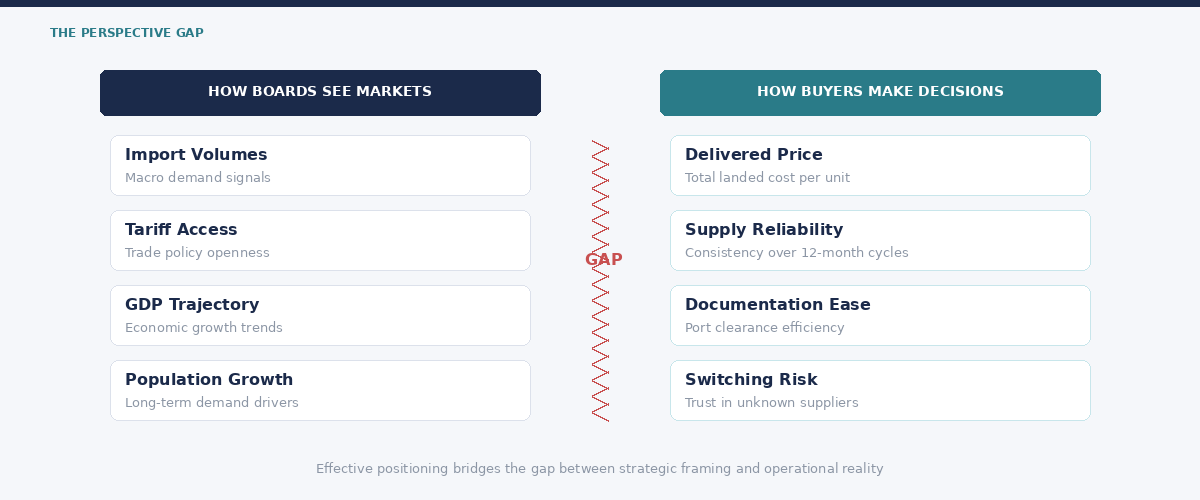
One of the most persistent gaps in export promotion is the distance between how boards think about their markets and how buyers in those markets actually make purchasing decisions. Boards tend to frame opportunity in macro terms: import volumes, tariff access, GDP trajectory, consumption trends. Buyers think in operational terms: price per unit delivered, reliability of supply over a twelve-month cycle, ease of documentation at the port, consistency of specification across shipments, and the reputation risk of switching from a known supplier.
That disconnect is not trivial. It means that a market can look highly promising from a strategic planning perspective while presenting significant friction at the transactional level, friction that determines whether a first order becomes a second one.
In our work across multiple commodity categories and regions, we consistently find that the most effective positioning strategies are built from the buyer’s decision architecture outward, not from the exporter’s value proposition inward. The difference sounds subtle, but it reshapes nearly every tactical choice from pricing structures to packaging formats to the cadence of in-market engagement.
Assumed Advantage Is Not the Same as Perceived Advantage
U.S. agricultural products carry a well-understood set of attributes: food safety standards, traceability, supply consistency, and production scale. These are real advantages. In certain markets and segments, they are decisive.
But advantage only matters if the buyer perceives it, values it, and is willing to pay for it or at least factor it into a purchasing decision that involves multiple competing considerations.
In practice, the gap between assumed and perceived advantage tends to manifest in predictable ways. In cost-driven segments, buyers may acknowledge quality differences but purchase on delivered price regardless. In markets with strong domestic production, traceability and food safety may be expected of all credible suppliers, not just U.S. ones. In these instances, what might have been differentiated attributes in one market are baseline qualifiers in another. In regions where competing origins have invested in long-term distributor education and relationship building, U.S. product may be seen as a viable alternative but not a preferred one, simply because the incumbent has earned trust that the newcomer has not.
None of this diminishes the real strengths of U.S. supply. It simply means that competitive positioning must be calibrated to what specific buyers in specific channels actually prioritize, not what exporters believe they should prioritize.
Positioning Is Local, Even When the Product Is Global
A commodity board promoting the same product across twelve target markets will encounter twelve different competitive landscapes. The suppliers vary. The channel structures vary. Buyer expectations, regulatory environments, and cultural associations with origin all vary. What works as a positioning lever in Southeast Asia may be irrelevant in North Africa.
This reality creates a tension that boards must manage carefully. On one hand, there is legitimate pressure to maintain a consistent global brand message. On the other, effective positioning demands adaptation to local competitive realities.
The boards that navigate this tension well tend to distinguish between identity and emphasis. The core attributes of U.S. supply remain the identity including consistency, safety, reliability. But which attribute is emphasized, how it is communicated, and through which channel it is delivered varies by market based on what local buyers respond to and what gaps incumbents leave exposed.
In one market, reliability of supply during peak demand windows may be the differentiator that earns trial. In another, specification flexibility and the willingness to adjust formats, pack sizes, or labeling to meet local norms may be the deciding factor. In a third, it may be as straightforward as demonstrating a credible, physically present commitment to the market through trade shows, in-market technical support, or sustained importer engagement.
These are not marketing decisions in the conventional sense. They are strategic resource allocation decisions and they require intelligence that secondary data and trade statistics alone cannot provide.
Displacing an Incumbent Is a Different Problem Than Entering an Open Market
Much of the export opportunity available to U.S. commodity boards exists not in unserved markets but in markets currently supplied by established competitors. That distinction changes the nature of the positioning challenge considerably.
Incumbent suppliers enjoy structural advantages that are easy to underestimate. They have established logistics pathways. Their documentation processes are familiar to local customs authorities. Their importers have invested in cold-chain and warehousing capacity configured for their specifications. And perhaps most importantly, they have accumulated trust, the kind that comes from years of consistent delivery, resolved complaints, and personal relationships between sales teams and buyers.
Displacing that position requires more than a superior product at a competitive price. It requires identifying the specific conditions under which a buyer would accept the risk of switching. Those conditions are rarely abstract. They tend to be concrete and situational: an incumbent’s supply disruption, a specification failure that damaged the buyer’s own customer relationship, a regulatory change that altered the cost equation, or a format innovation that the incumbent has not matched.
Boards that understand these switching triggers and can position U.S. supply as the credible alternative when they occur are far more effective than those that rely on broad promotional activity and hope that awareness alone will shift behavior.
Intelligence That Shapes Positioning Must Come From the Field
The insights that inform effective competitive positioning such as buyer decision criteria, incumbent vulnerabilities, channel-specific dynamics, and switching triggers are not available in trade databases. They live in the operational reality of individual markets: in conversations with importers, distributors, food processors, and end buyers who make purchasing decisions every day.
This is where primary research becomes indispensable. Not as a one-time exercise to justify a market entry decision, but as an ongoing intelligence function that keeps positioning strategies calibrated to market conditions as they evolve.
Effective field intelligence answers the questions that secondary data cannot: What would it take for this importer to trial a new origin? What does this distributor’s assortment strategy look like, and where are the gaps? How do end users in this channel evaluate quality by origin, by specification, by brand, or by the recommendation of their supplier? What operational constraints limit the buyer’s willingness to change, even when the economic case is favorable?
When commodity boards invest in this kind of intelligence, they move from promoting products to positioning solutions. The shift is substantial. Promotion says, “Our product is excellent.” Positioning says, “Our product solves the specific problem you are trying to solve, in the way your operation requires it to be solved.”
From Market Access to Market Relevance
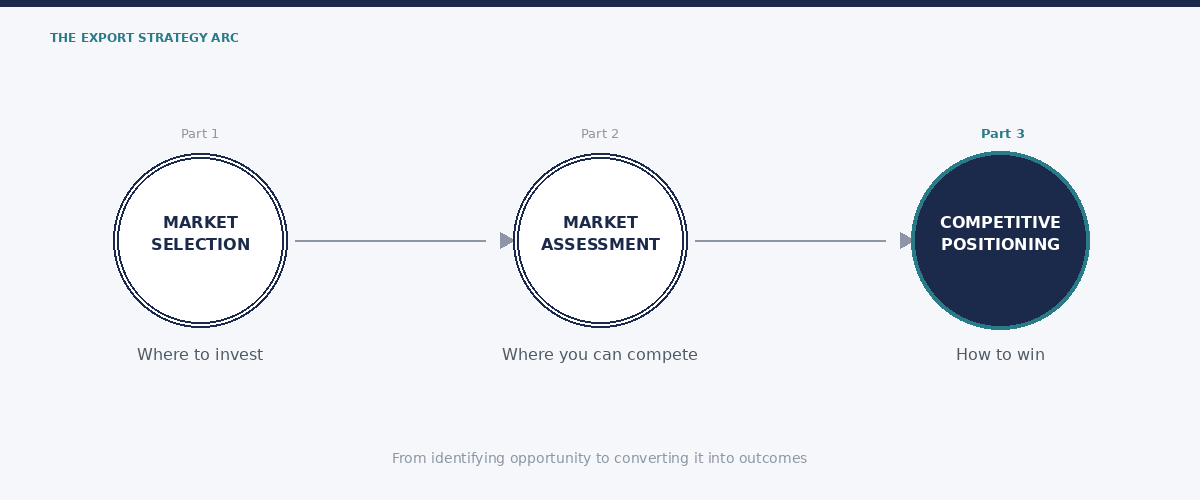
Across this three-part series, we have traced an arc that reflects how we believe export strategy should evolve for U.S. agricultural commodity boards. Part 1 argued that disciplined research transforms market selection from an exercise in ambition to an exercise in evidence. Part 2 explored how rigorous assessment separates markets that look attractive from those where the U.S. can realistically compete. This final installment makes the case that competitive positioning grounded in buyer-level intelligence and adapted to local realities is what converts market access into market outcomes.
The commodity boards that will capture the most value from current funding environments are not those that pursue the most markets or deploy the most dollars. They are the ones that understand, with specificity, where U.S. supply holds genuine advantage and position accordingly. That understanding does not come from dashboards or desk research alone. It comes from sustained engagement with the markets themselves, through the kind of primary intelligence that reveals how decisions are actually made and what it takes to influence them.
Export growth is not a function of presence. It is a function of relevance earned market by market, buyer by buyer, decision by decision.