

Why the Fastest Path to Product-Market Fit Is More User Feedback Cycles, Not More Features
There is a quiet arms race happening in product development right now, and it has nothing to do with who has the best model, the biggest engineering team, or the most advanced tech stack. The teams pulling ahead, the ones building products that customers actually love, are winning on something deceptively simple: the speed and frequency of their user feedback cycles.

Andrew Ng, the Stanford professor and AI pioneer, put it bluntly in a recent CS230 lecture: “The engineers who learn to talk to users, get feedback, and develop deep empathy for users so that they can make decisions about what to build, those engineers are also the fastest-moving people that I’m seeing in Silicon Valley today.”
That insight resonates far beyond Silicon Valley and far beyond software. Whether you’re a product manager at a Fortune 500 manufacturer, a CPG brand owner launching a new SKU, a pharma team optimizing a delivery system, or an AI engineer building agentic workflows, the principle is the same: your competitive advantage, your alpha, lives in how many times you can complete the loop of building, listening, and improving before your competition does.
The Build Takes Less Time and Fewer Resources. Across Every Industry.
For decades, the primary constraint in product development was execution bandwidth. You had more ideas than you had hands to build them. Engineers would estimate timelines in weeks or months, and by the time a new product shipped, the market had often moved.
That constraint is evaporating, and not just in software.
In software, AI-assisted coding tools like Claude Code, OpenAI Codex, and Gemini are compressing build cycles from weeks to days, and sometimes from days to hours. Research from METR, cited in Ng’s Stanford lecture, estimates that the complexity of tasks AI can handle is doubling every seven months, with AI coding specifically doubling every 70 days. As Ng put it: “Things that used to take six engineers three months to build, my friends and I, we’ll just build on a weekend.”
But the same compression is happening across physical product development, and in some ways it started there first.
In manufacturing, AI-driven generative design is reducing design cycle times by 50 to 70 percent and achieving material savings of 20 to 40 percent through topology optimization. Digital twin technology cuts development timelines by 20 to 50 percent while improving product performance. According to a 2026 Protolabs report, 72 percent of manufacturers that have integrated machine learning into their processes report reduced costs and improved operational efficiency. NASA and Protolabs demonstrated what’s possible: a generative design went from conception to finished machined part in just 36 hours.
In automotive, virtual prototyping now allows engineers to begin software development months before silicon is available, accelerating vehicle time-to-market by up to 12 months. Synopsys demonstrated at CES 2026 that virtualizing vehicle electronics for design, integration, testing, and validation can cut costs by 20 to 60 percent. Tesla’s over-the-air update model has operationalized this at scale, using real-world driving data and customer feedback to continuously refine both software and hardware.
In pharma, AI-driven platforms are compressing the drug discovery pipeline. AstraZeneca built an internal MLOps framework for rapid prototyping of AI approaches while maintaining audit trails. Merck KGaA’s BayBE framework enables closed-loop experimentation, and Sakana AI’s “AI Scientist” demonstrated a complete autonomous research loop from idea generation through experiments to paper drafting. Lilly’s TuneLab, launched in late 2025, hands AI suite access to select biotechs in exchange for data-sharing to grow the underlying models.
In consumer goods and appliance manufacturing, Midea Group has committed over $7 billion to AI, robotics, and advanced manufacturing over three years. Their Thailand factory, named a World Economic Forum Lighthouse Factory for supply chain resilience, is the first overseas Lighthouse Factory in the global air-conditioning industry. Their Chongqing chiller factory became the world’s first full-process AI-empowered manufacturing facility. And their DeepSeek-powered air conditioner, the Fresh Sense Air Machine T6, uses AI for multi-dimensional self-perception, self-learning, and self-adjustment of indoor air quality.
The pattern is universal. Across every product category, AI and advanced tools are collapsing the time and cost required to build, prototype, and iterate. The 2026 Protolabs Innovation in Manufacturing report found that AI-enabled digital threads achieve a 50 percent reduction in development costs and 30 percent faster time to market. Forty-seven percent of product development teams plan to use generative AI at scale.
The implication is consistent regardless of industry: the scarce resource is no longer the ability to build. It’s the ability to know what to build. And the single best way to know what to build is to ask the people who will use it.
The Feedback Cycle: Build, Listen, Improve, Repeat
Ng described the workflow that defines the fastest teams he sees: “I often think of going through a loop where we’ll write some code, show it to users, and get user feedback. Based on the user feedback, I’ll revise my view on what users like, what they don’t like, whether the UI is too difficult, and which features they want. I change my conception of what to build and then go around this loop many times to iterate toward a product that users love.”
Replace “write some code” with “machine a prototype,” “formulate a compound,” or “configure a PTAC system,” and the loop still works. This isn’t a new concept. Eric Ries formalized it as the “Build-Measure-Learn” loop in The Lean Startup over a decade ago. But what has changed is the speed at which the “Build” phase can happen across all product categories, which makes the “Measure” and “Learn” phases disproportionately more valuable.
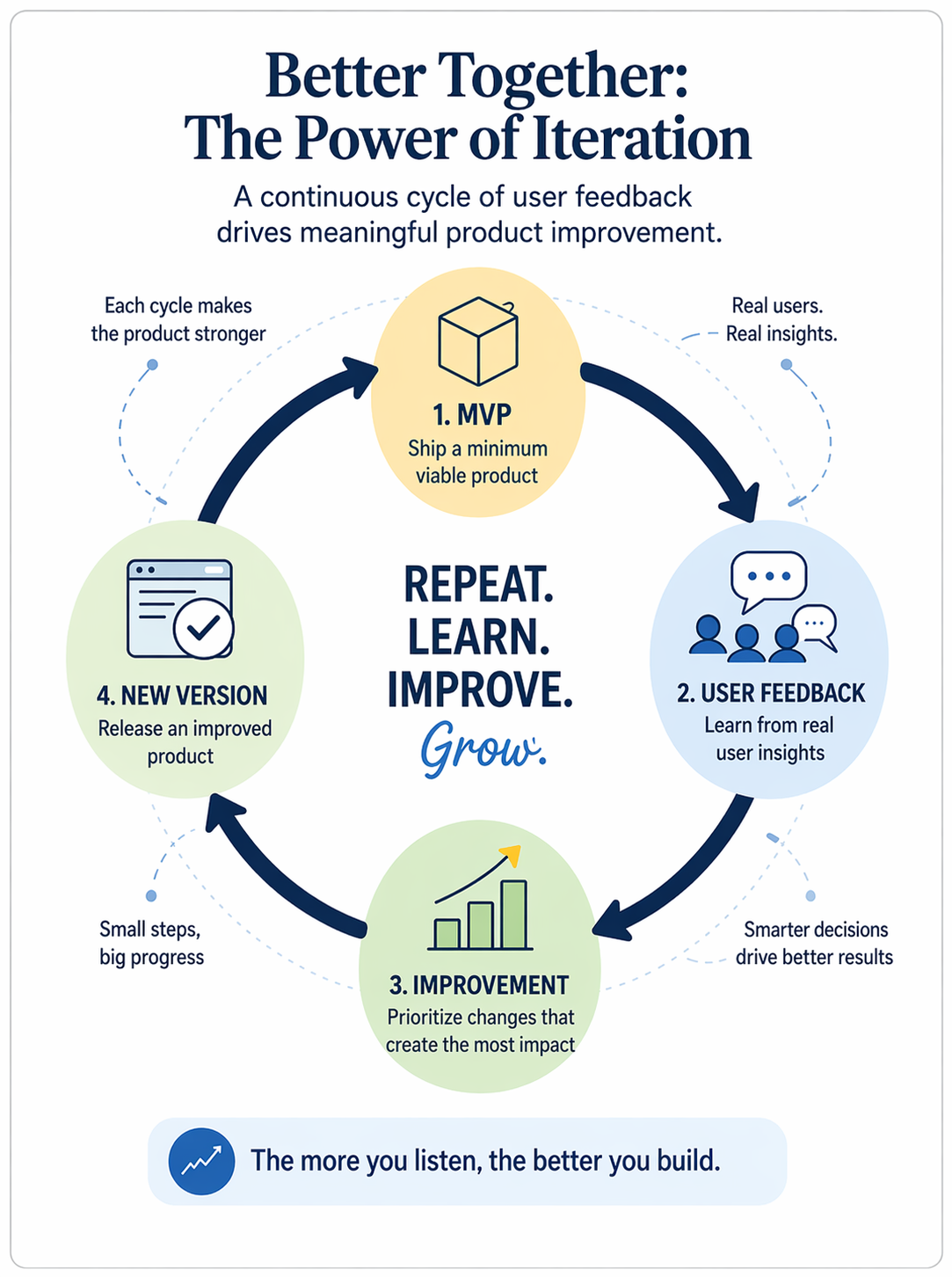
The Feedback Cycle: each revolution brings the product closer to what users actually want.
Here’s how each phase works in practice, regardless of whether you’re shipping software, physical products, or services:
Build: Ship the Minimum Viable Version
With AI-assisted tools, the first version of nearly anything can be stood up faster than ever before. In software, that’s a working prototype in hours. In manufacturing, it’s a generative design rendered and validated through simulation in days rather than weeks. In CPG, it’s a concept tested in qualitative co-creation sessions before a single production run. The goal is not perfection. It’s a functional artifact that customers can react to. A working prototype, concept board, or pilot program generates infinitely more useful feedback than a slide deck or an internal specification document.
Deploy: Put It in Front of Real Users
This is where most teams stall. They build in isolation, polishing features that no one asked for. The fastest teams ship early and imperfect, because they understand that user contact is the information-generating event. Every day the product sits unshipped is a day of learning lost.
In hardware and manufacturing, “deploy” might mean putting a constrained-functionality prototype in front of contractors on a real job site, running a limited production batch for a key account, or conducting a field trial with actual operators. The form factor changes, but the principle is identical: get it into the hands of people who will use it, as fast as you can.
Listen: Gather Feedback Systematically
Here’s where most product teams underinvest, and where the best ones pull away.
Listening is not passive analytics. It’s not NPS surveys. It’s not reading app store reviews. Listening, done right, is primary research applied to product development: active, structured conversations with real users about what works, what doesn’t, and what they wish existed. It’s the qualitative depth of focus groups combined with the quantitative rigor of MaxDiff scaling and conjoint analysis. It’s the difference between knowing that customers are dissatisfied and understanding why they are, what would change their behavior, and what they would trade off to get it.
The data backs this up. Organizations that involve product managers, engineers, and support teams in the feedback process report 31 percent better product decisions and up to 24 percent less development waste, according to recent research on continuous feedback integration. Companies that prioritize structured customer feedback loops achieve up to 60 percent higher profits than competitors. And 85 percent of companies that prioritize customer feedback see an increase in revenue.
We’ll come back to this, because it’s where the real competitive separation happens.
Improve: Iterate and Re-enter the Loop
Synthesize what you’ve heard, reprioritize what to build next, and spin the wheel again. Each revolution of the loop brings the product closer to genuine product-market fit, not the imagined version in the team’s head, but the version that users actually endorse with their behavior and their wallets.
The Learning Loop: A Loop Within the Loop
Here’s where the concept gets more powerful, and more specific.
The Build-Listen-Improve cycle describes what your product team does. But inside the “Listen” phase, there’s a deeper, more rigorous loop that the best organizations run: a structured learning process that transforms raw user contact into validated insight, strategic clarity, and confident action.
We call this the Learning Loop.
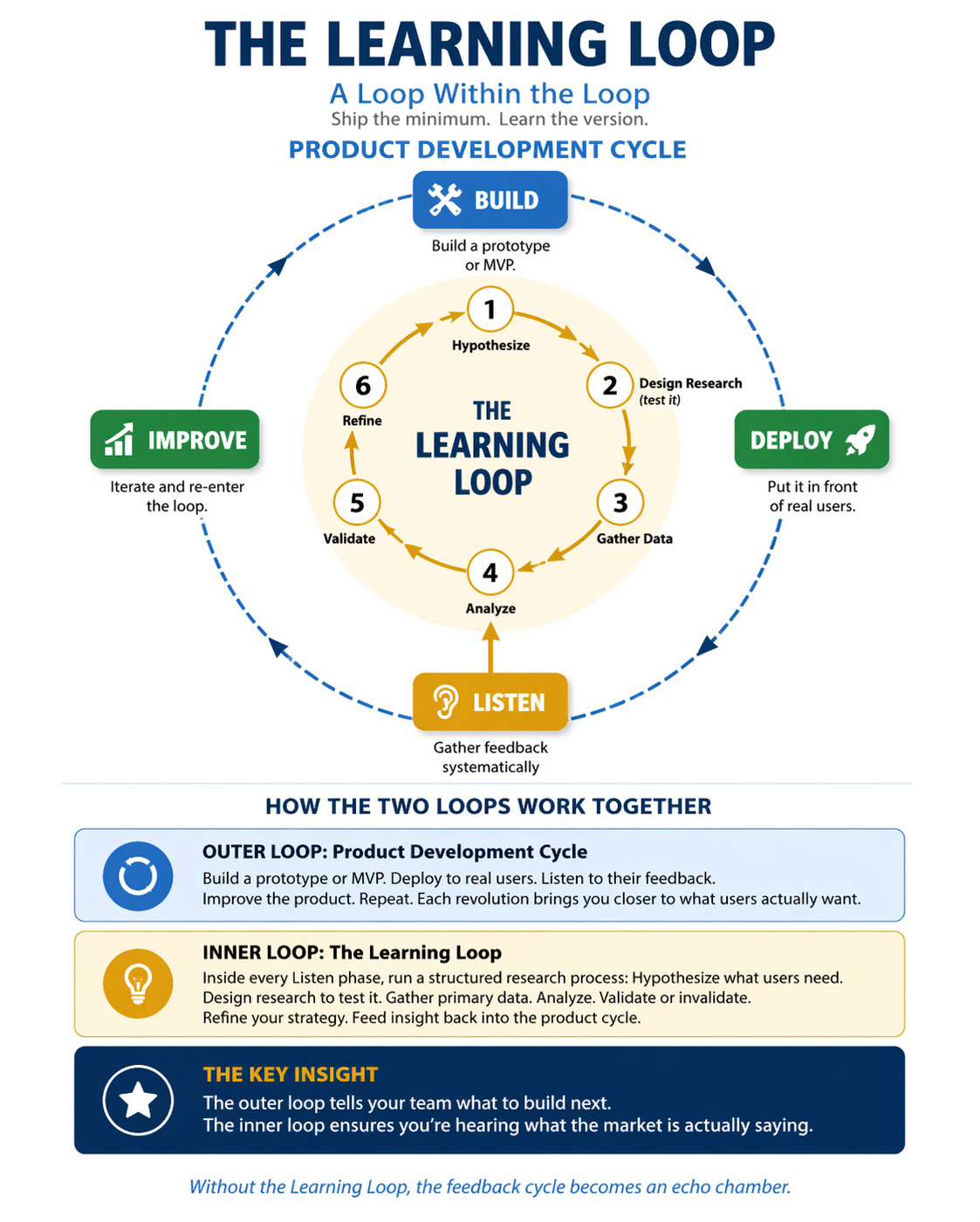
The Learning Loop: a structured research process nested inside the Listen phase of the product development cycle.
In practice, the Learning Loop turns raw user feedback into market intelligence through six steps:
- Hypothesize. Before you talk to anyone, articulate what you believe about the market, the user, and the opportunity. What needs do you expect to find? What tradeoffs do you think users are making? What assumptions underpin your product roadmap?
- Design the research. Structure your inquiry so it will actually test those hypotheses. This means crafting discussion guides that probe for the “why” behind behavior, designing quantitative instruments that measure importance, satisfaction, likelihood to switch, and problem frequency. It means building conjoint exercises that reveal what users would actually trade off, not just what they say they want.
- Gather primary data. Go talk to real users, buyers, specifiers, installers, operators, end consumers. Use qualitative methods (in-depth interviews, co-creation sessions, ethnographic observation) to discover what you didn’t know to ask. Use quantitative methods (surveys, MaxDiff, discrete choice) to measure what matters at scale.
- Analyze and synthesize. Move from transcripts and data tables to insight. What patterns emerge? Where do segments diverge? What surprised you? What confirmed your hypothesis, and what contradicted it?
- Validate or invalidate. Update your beliefs. This is the hardest step because it requires intellectual honesty. If the data says your flagship concept doesn’t resonate, you need to act on that, not explain it away.
- Refine strategy and re-enter the product loop. Feed the validated insight back into the product development cycle. Change what you build, how you position it, or who you build it for. Then build again, deploy again, and listen again.
Without structured primary research inside the “Listen” phase, the broader feedback cycle becomes an echo chamber. Teams default to the loudest customer, the most recent complaint, or the CEO’s intuition. Those signals matter, but they aren’t systematic, and they don’t reveal what the market as a whole is telling you.
This is the intelligence advantage that builds over time. Every revolution of the Learning Loop deepens your organization’s understanding of your customers, your market, and the gap between what exists and what’s needed. Your competitors can’t replicate that knowledge by copying your feature set. The insight that led to that feature set was earned through direct user contact that they didn’t run.
Frequency Is the Alpha
In investing, “alpha” refers to returns above what the market delivers, outperformance driven by insight or skill rather than just riding the index. In product development, the equivalent alpha comes from information asymmetry: knowing something about what users need that your competitors do not.
Every completed feedback cycle is a data point your competitors don’t have. If you’re running weekly feedback loops and your competitor runs them monthly, you accumulate roughly four times the user intelligence per quarter. Over a year, that gap grows into a product that is dramatically more aligned with real demand.
Companies that prioritize structured customer feedback loops achieve up to 60 percent higher profits than competitors, according to research cited by multiple product management organizations. Teams that introduce formal feedback triage processes resolve around 40 percent more issues and ship 25 percent more user-requested features.
As Ries put it in the Lean Startup methodology: “The better the hypotheses and measurements, and the faster each cycle can be completed, the better and more the innovation team will learn and the greater their competitive advantage.” Speed of iteration is not a nice-to-have. It is the advantage itself.
And note what Ries emphasized: “the better the hypotheses and measurements.” Spinning the loop fast with weak listening yields noise. Spinning it fast with disciplined primary research yields compounding insight. The quality of the Learn phase determines whether your speed creates value or just velocity.
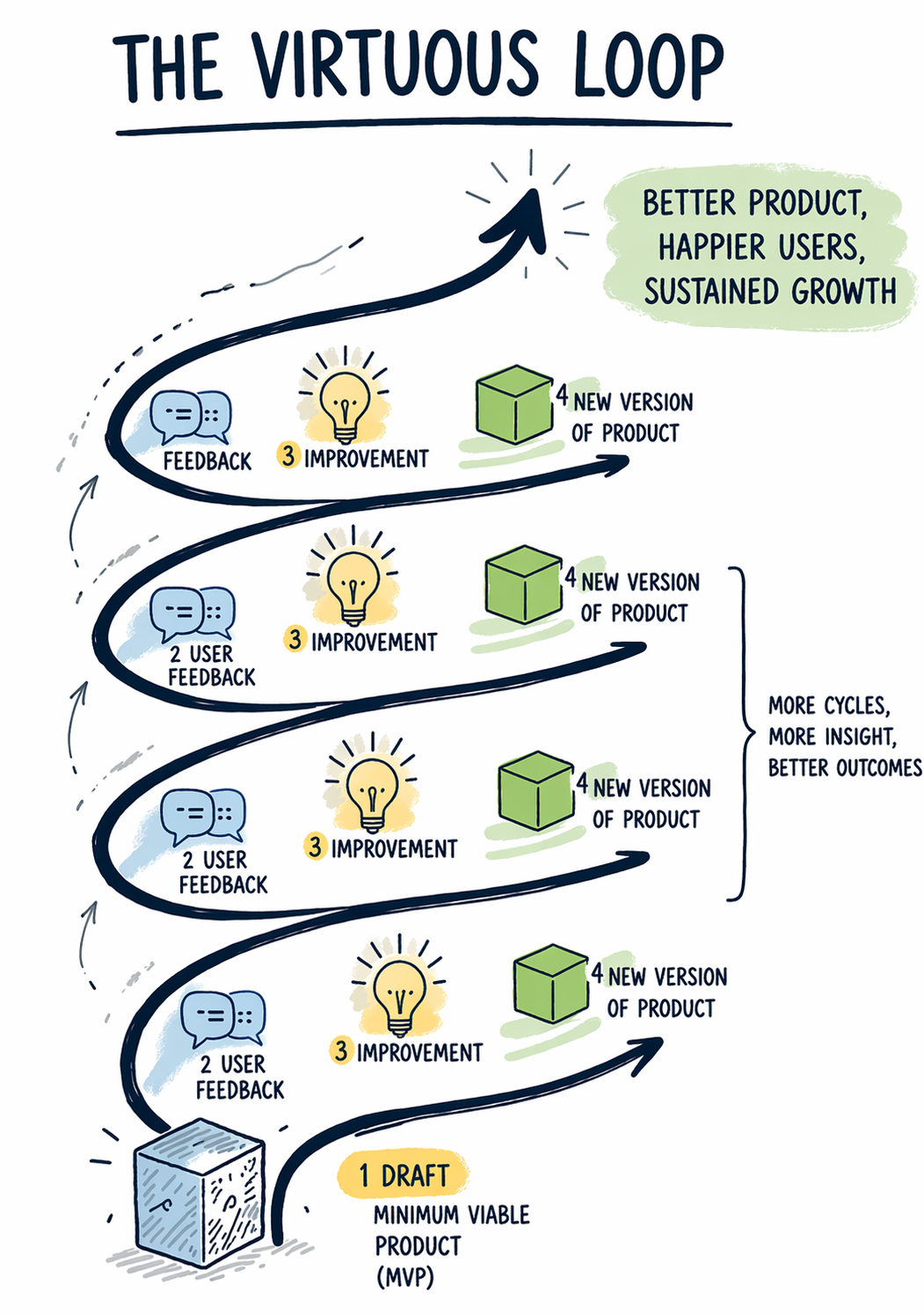
More cycles, more insight, better outcomes: the compounding effect of running feedback loops faster than your competition.
This Isn’t Just for Software Companies
The feedback loop is industry-agnostic. It applies everywhere a product or solution meets a user. Here’s what it looks like outside of software:
Manufacturing and industrial products. Consider a building products manufacturer deciding whether to commit to tooling on a new fastening system. The traditional approach: design in a lab, produce samples, launch, and hope. The feedback-loop approach: put a constrained-functionality prototype in front of contractors on a real job site. Watch them install it. Ask them what didn’t work. Iterate before committing capital. The manufacturers who ground product decisions in primary research conducted with real end-users under real job-site conditions are the ones whose R&D investment actually converts to market share.
Consumer goods and appliances. Midea’s $7 billion AI and robotics investment is accelerating what they can build. But the strategic decisions (which concepts to pursue, which markets to enter, which features matter most) still require structured research. Qualitative co-creation sessions where consumers iteratively refine product propositions, combined with quantitative validation through methods like MaxDiff and conjoint analysis, produce the insight that directs where those R&D dollars should go. Speed without direction is just expensive experimentation.
Pharma and life sciences. AI is compressing the discovery pipeline, but compounds still fail commercially when developers skip structured engagement with the people who prescribe, administer, and pay for treatments. Faster building raises the premium on understanding what patients and clinicians actually need.
The same logic extends to enterprise IT teams running internal feedback cycles with end-users, to professional services firms building check-in rhythms with clients instead of disappearing for weeks between deliverables, and to AI engineers building agentic systems where user expectations are still forming and the design space is enormous. In every case, the team that listens fastest and most rigorously wins.
A Practical Playbook: Accelerating Your Feedback Loops
If you want to operationalize this, here are six concrete moves:
1. Ship before you’re comfortable.
If a prototype takes a day to build with AI assistance, waiting a week for internal review before showing it to users is, as Ng put it, “really painful.” Set a rule: no version lives more than 48 hours without user eyes on it. In hardware, that might mean 48 hours to get a simulation in front of a key account engineer rather than 48 hours to a shipped product, but the principle holds.
2. Invest in the Listen phase as seriously as you invest in the Build phase.
This is the single highest-leverage change most organizations can make. The Build phase is getting cheaper and faster by the month. The Listen phase, the structured practice of learning from users through primary research, is where differentiation now lives.
Too many product teams treat listening as an afterthought: a customer advisory board that meets twice a year, a post-launch survey, a sales team that relays anecdotes in a Monday meeting. That approach worked when building was slow and expensive, because you only had so many chances to get it right. Now that building is fast and cheap, you can (and should) be learning from users at every stage: before you build, during development, immediately after deployment, and continuously as usage patterns evolve.
Treat user feedback the way you would treat primary research for a strategic decision, because that’s exactly what it is. Structure your inquiry. Define hypotheses. Use mixed methods (qualitative for depth, quantitative for scale). Synthesize rigorously. And act on what you find, even when it contradicts your assumptions.
3. Collapse the builder-listener gap.
The engineer who writes the code, designs the product, or formulates the compound should be the same person (or at least in the same room as the person) who hears the feedback. Ng’s observation about collapsing the engineer and PM into one role is about minimizing information loss. Every handoff between “the team that builds” and “the team that listens” introduces latency and distortion.
In manufacturing, this means getting product engineers into the field during user testing, not just reading a summary from the market research team. In pharma, it means having formulation scientists hear directly from clinicians about real-world usage challenges. The closer the builder is to the user, the faster the insight converts to action.
4. Measure loop velocity, not just output.
Track how many complete Build-Listen-Improve cycles your team runs per month. If you’re completing one loop per quarter, you’re losing to teams completing one per week (in software) or one per month (in hardware). Loop velocity is a leading indicator of product success. Output without feedback is just inventory risk.
5. Run the Learning Loop inside every Listen phase.
Don’t settle for casual feedback. Every time you put a product in front of users, run the full Learning Loop: hypothesize, design the research, gather primary data, analyze, validate or invalidate, and feed the insight back into the product cycle. This turns every user touchpoint into a strategic intelligence event, not just a temperature check.
6. Treat your accumulated learning as a competitive asset.
Every completed loop builds your organization’s understanding of the market. Document what you learn. Build a knowledge base of validated insights, failed assumptions, and emerging patterns. Over time, this becomes your competitive edge: hard-won knowledge about your users that your competitors would need years of their own primary research to replicate.
The Teams That Win Will Be the Teams That Listen Fastest
AI has compressed the build phase to near-zero marginal time for many product categories. That’s remarkable, and it changes everything about how product teams should allocate their time and attention. But the teams that treat faster building as a reason to ship more features, more SKUs, or more product variants are missing the point. The real gift of cheap, fast building is the ability to complete more feedback loops in the same amount of time.
Every revolution of the cycle (build, deploy, listen, improve) brings you closer to the product your users actually want. And the Learning Loop inside each listen phase is what ensures that you’re hearing what users are actually telling you, not just going through the motions.
Andrew Ng sees it from the engineering side. Eric Ries saw it from the startup side. Every product leader who has watched a concept die in the market after succeeding in the lab knows it intuitively: the closer you stay to the source of truth, the user, the better your decisions get.
The feedback loop is the new moat. Build it wider and run it faster than everyone else. And invest in the listening that makes every revolution count.
Sources & References
Andrew Ng, Stanford CS230 Lecture 9: Career Advice in AI, Autumn 2025.
Eric Ries, The Lean Startup (Crown Business, 2011). Build-Measure-Learn methodology.
Protolabs, “Innovation in Manufacturing 2026.” AI-enabled digital thread statistics and generative design examples.
ResearchGate, “Enhancing Product Development through Continuous Feedback Integration,” 2024.
Midea Group corporate disclosures, 2025-2026. R&D investment and Lighthouse Factory designations.
Synopsys, “AI-Driven, Software-Defined Automotive Engineering,” CES 2026. Virtual prototyping cost and timeline data.
LaunchDarkly, “What Is a Product Feedback Loop?” 2025.
Hubble, “Establishing a Product Feedback Loop for Continuous Improvement,” 2025.
Pharmaceutical Technology, “From AI to Smart Factories: How Pharma Is Preparing for 2026.”
ITONICS, “How the Best R&D Teams Build-Measure-Learn Their Way to New Products.”