Chicago

+1 (312) 606-9690

1603 Orrington Avenue
Suite 305

Evanston, Illinois 60201

Detroit

+1 (248) 327-8000

202 E 3rd Street
Suite 200

Royal Oak, Michigan 48067

Frankfurt

+49 (69) 80903
60
Berliner Strasse 219

D-63067 Offenbach/Main

Shanghai

+86 (21) 6015-9588

Building 3, 5/F
3601 Dongfang Road

Pudong, Shanghai 200120

Market Analysis Whitepaper

MAR - Newsletter Header (1080 x 800 px)

Need the best-available intelligence on your market?

The most thorough and reliable way to conduct TAM Analysis research is through a process we call “Triangulation.”

In the fast-paced world of private equity (PE), making well-informed investment decisions is critical to delivering returns to limited partners (LPs) and maintaining a competitive edge.

Misunderstanding the size of your target’s market or miscalculating the potential upside gain or downside risk associated with a given market opportunity can have significant ramifications on the future of your business.

Our newly released Market Analysis Whitepaper offers a detailed exploration into why leadership is embracing this methodology, how Triangulation works, and the benefits realized through this robust approach to market sizing. 

Download Whitepaper Now

Receive the full-length, in-depth whitepaper that explores these concepts in illustrative detail. Simply complete this form to receive instant access to the whitepaper:

"*" indicates required fields

This field is for validation purposes and should be left unchanged.
Name

👉 To view a preview of the full-length, in-depth whitepaper available above, click here >> (no form fill required). The preview provides a high-level overview of the triangulation methodologies explored more deeply in the full-length document, which provides deeper analysis and an illustrative case study.

What’s Inside:

Market Size Triangulation research projects often stem from key strategic questions raised to ensure investors keep their “eye on the prize.”

  • Is the potential target selling to the right customers through the right channels?
  • Is it keeping up with the market?
  • What are the biggest opportunities that could drive revenue growth?
  • Have new competitors emerged that threaten the target’s market position and share?

The Martec Group employs this Triangulated research approach to answer such questions, which encompasses three primary sources of information:
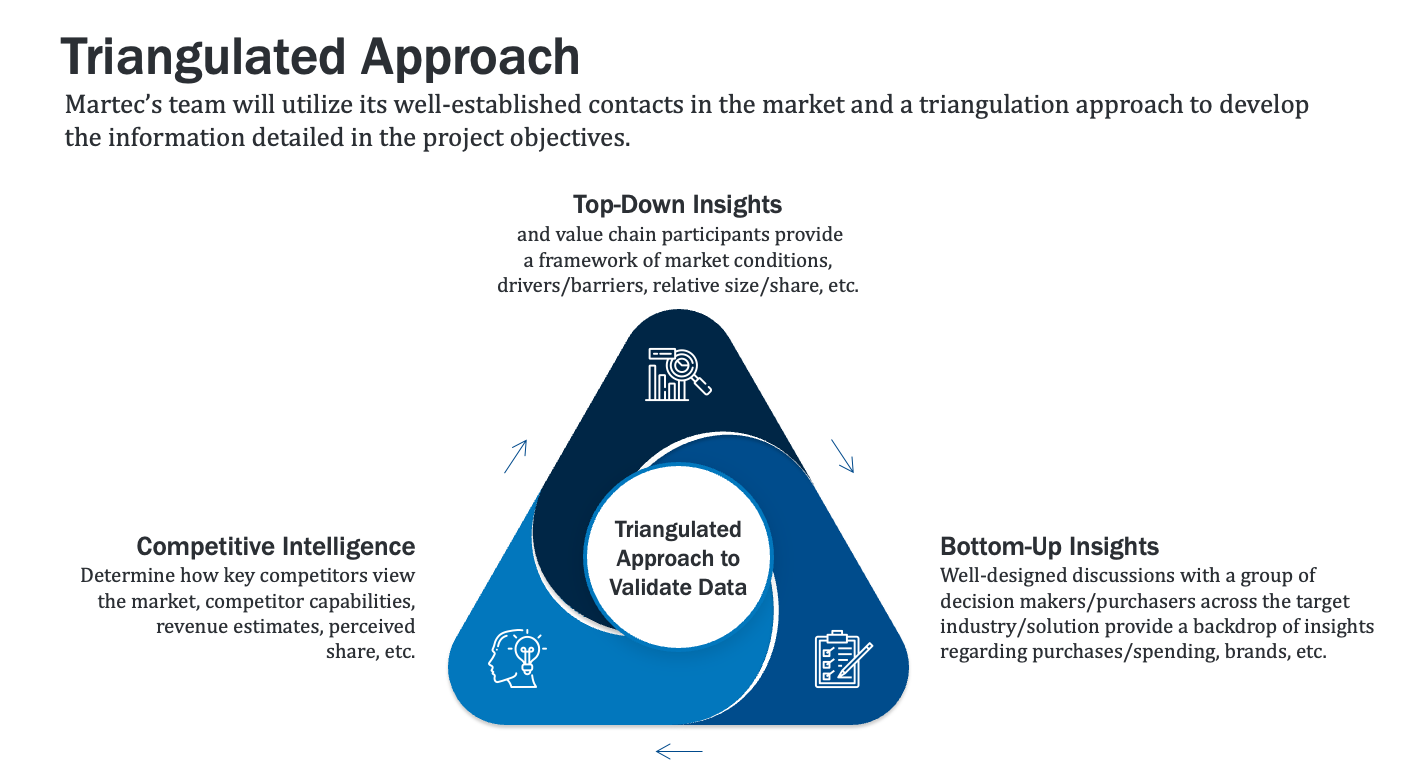
📓 Published Information

Published data often is useful as a starting point, but has accuracy and growth limitations, and can become outdated over time.

⬇️ Top-Down Insights
Top-Down Insights focus on what was sold, but typically don’t include robust statistical insights such as purchase incidence, purchase frequency, preferred channel, or other purchaser-centric metrics.

⬆️ Bottom-Up Insights
Bottom-Up Insights reveal “what was purchased,” but such inputs are recall-based and could be skewed by poor memory and (aspirational) brand halos.

It is only through the combination of all three sources of information that one can triangulate a true, data-informed market size. When taken together and examined in totality, this intelligence triangle allows us to zero in on a much tighter, far more precise, and further validated range of a given market size.

Triangulation provides all three legs of the critical stool of intelligence. 

Download the preview to  “Market Analysis: A Triangulated Approach to Analyzing TAM,” today.

Subscribe To Our Newsletter
Get The Latest Insights

Leading #MRX Posts

B2B

Applying Minimax Thinking to Uncertain Pricing Decisions

Many pricing decisions assume markets behave uniformly. In reality, customer responses frequently vary based on switching costs, competitive alternatives, technical requirements, contractual structures, and the ability to pass costs through. A customer with multiple qualified alternatives may react very differently than a customer operating within a highly specialized application.

The debate begins almost immediately.

Read More »
Pricing Research

The Pricing Question Most Companies Never Ask

In its simplest form, minimax encourages decision-makers to consider the worst plausible outcome associated with each available option. Rather than focusing exclusively on the most likely result, it asks leaders to understand the downside attached to being wrong. For pricing teams, that perspective can be surprisingly valuable.

Read More »
Automotive + Transportation

In a Tariff Environment, Finding and Protecting Margin Isn’t Optional

At first glance, pricing in a tariff environment appears straightforward. Input costs rise by 20%, prices rise by 20%, and margins are preserved. The logic is simple and often serves as the foundation for internal pricing discussions. The problem is that customers do not make purchasing decisions based on your cost structure. They make purchasing decisions based on the value they receive and the alternatives available to them.

Read More »
Scroll to Top