

How to Leverage a Triangulated Approach to Market Sizing and Modeling
NOTE: This success story originally appeared as part of our recently released eBook, “Actionable Research for Uncertain Times: A Triangulated Approach to Market Sizing,” available for download here.
Insights Sought and Outcome Delivered
A Martec client is a leading supplier of power tools and accessories for construction professionals. As part of its market and long-term planning processes, it required an evaluation of market potential with the U.S. professional power tools industry. Ultimately, by taking a triangulated approach to Market Sizing Analysis, this manufacturer was able to increase its sales and market share by taking a data-informed and carefully calculated approach to national expansion.
The Challenge and Opportunity
This client was interested in understanding both a holistic view of the U.S. professional tools market and an in-depth estimate of the market size/potential for the Top 50 Metropolitan Statistical Areas (MSA) in the United States. Core objectives for the research included:
- A detailed understanding of the size and growth of the U.S. professional power tools market
- Spending by product type
- Channel share
- Brand share
- Segmentation by trade
- Estimated market size for the Top 50 MSAs
- Including segmentation by product type, trade, and channel
To address these objectives, Martec conducted a fully triangulated market size analysis including published reports, a qualitative Top-Down market size analysis, and a quantitative Bottom-Up market size analysis, including statistical modeling for the Top 50 U.S. MSAs.
Research Executed
This multi-dimensional research project included all aspects of Martec’s Market Size Triangulation methodology:
- Published reports
- Qualitative Top-Down Insights (roughly 75 in-depth interviews with industry experts to validate “what was sold” in the power tools market)
- Quantitative Bottom-Up Insights (an online survey with more than 1,100 recent power tool purchasers)
- Statistical modeling based on overall market size estimates and MSA-level survey results
The need for market size estimates at the MSA level necessitated selecting and targeting representative MSAs for the survey work. The MSAs were selected for the survey based on their size (small, medium, and large MSAs); geography (covering all U.S. regions), economic activity, and growth (based on MSA-level GDP); construction activity (based on Dodge construction activity/forecast data); and construction intensity (construction activity per capita).
As a key point of triangulation, a holistic U.S. market size was generated using a Top-Down qualitative effort. The overall U.S. market size was then used to validate the Bottom-Up, MSA-level market size estimates.
The survey results from six key MSAs were used to generate detailed market size estimates for the remaining Top 50 MSAs through advanced statistical modeling, including several key metrics that strongly correlated to the survey data:
- Economic activity
- Construction activity
- Population
- Number of professional tradesmen (by NAICS)
Results Delivered
This detailed research process yielded a robust market size analysis at both the national and MSA level.
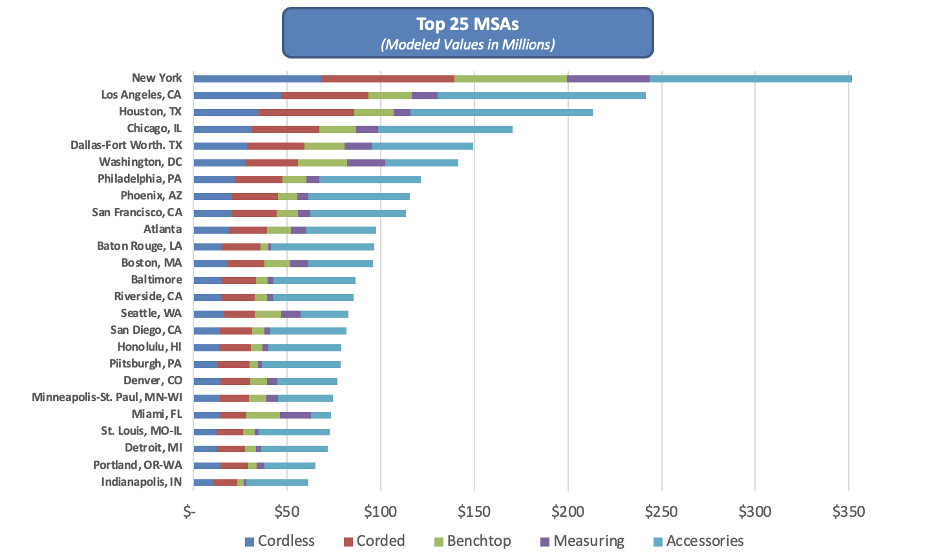
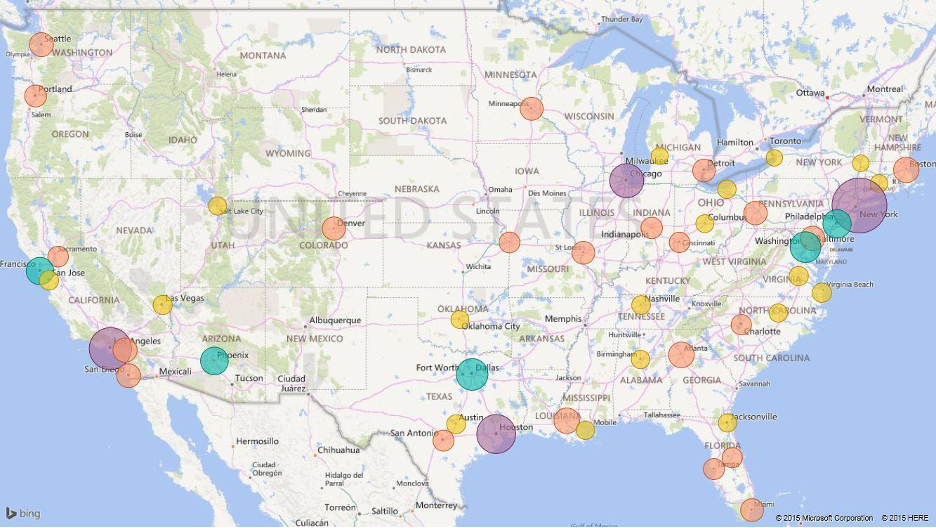
The data was then used to identify geographies/MSAs in which the client was underperforming and could benefit from additional resources and/or personnel…
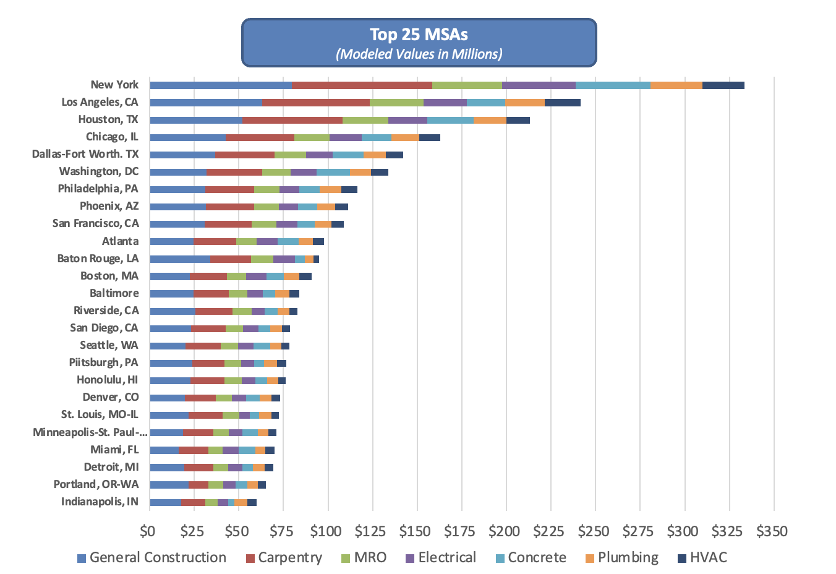
…as well as which tradesmen (and subsequently distribution partners) to target for growth.
Action Taken
Based on the research conducted, our client executed several initiatives to increase its market presence:
- Targeted specific MSAs to leverage anticipated market growth.
- Revised its channel strategy to benefit from changing purchase habits, Including an increased emphasis on both online channels and trade-specific distribution partners
- Increased its “feet on the street” in specific high-volume/high-growth MSAs
This investment in market sizing research ultimately helped this manufacturer increase its sales and market share and drive additional shareholder value to the bottom line.
Understanding More About Your Markets
Do you need help understanding your markets and optimizing your market position? Let’s have a conversation about what you need to know and how Martec can help answer your questions. Together we can understand both your current market and how that market will look in the next several years.